
Drawing conventions, fitness for purpose and rescue systems
Line types and scale on technical drawings, fitness for purpose, and hydraulic rescue systems. Read one part at a time and tap “I know this”. Then test yourself in the quiz.
Know it already? Jump straight to the quiz

Drawing conventions
- A working drawing is accurate, with all the measurements.
- Oblique projection: depth lines at 45°. One-point perspective: depth lines meet at one point on the horizon.
- A freehand sketch gets ideas down quickly. Always acknowledge your sources when you investigate.
Designing a rescue crane
- Design process in order: investigate, design, make, evaluate, communicate.
- Model crane: a crank winds a string over a pulley. The most important specification: it must not tip over when loaded.
- A counterweight balances the load. A bulb in the electromagnet circuit shows when the magnet is on.
- Evaluate: does the model meet all the specifications? Communicate with neat drawings, notes and the model.
Remember this and test yourself
- Outlines: thick and dark. Construction lines: thin and faint. Hidden edge: dashes.
- Centre of a circle or hole: a thin line of long and short dashes (chain line).
- Scale 1 : 10 and 5 cm on the drawing = 50 cm in reality.
- Fit for purpose: it does the job; cost effective: people can afford it.
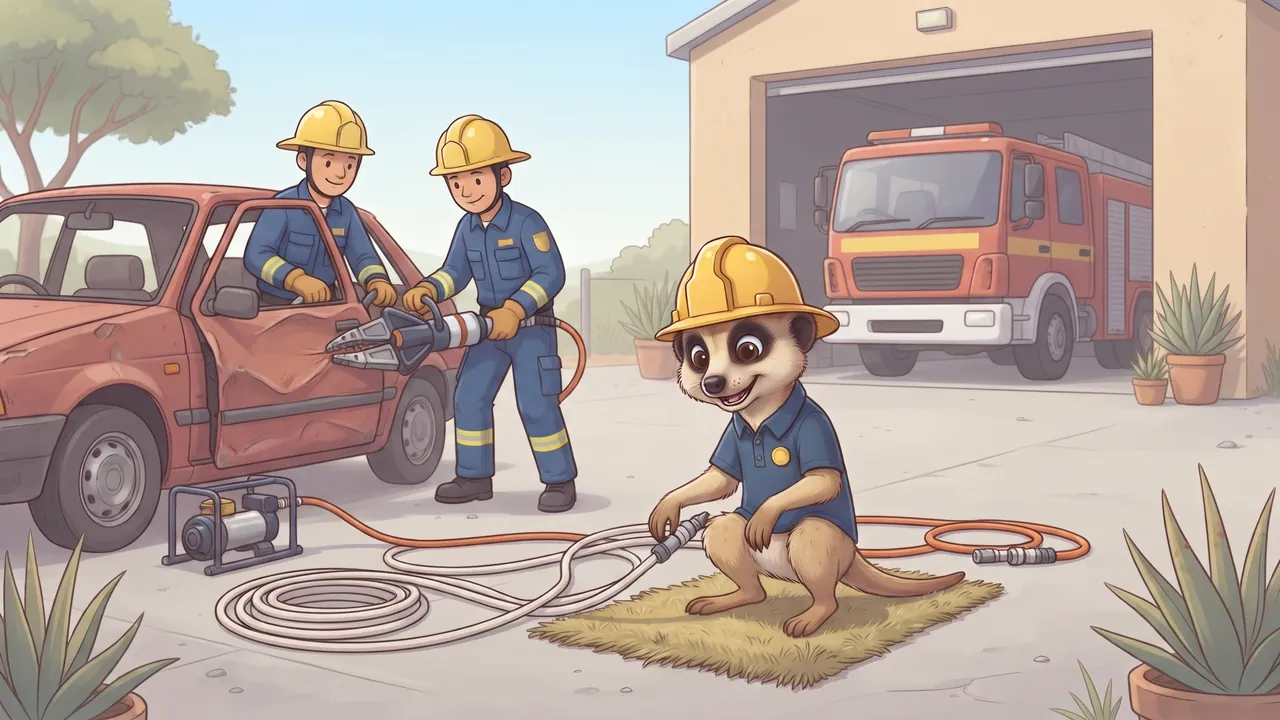
- The Jaws of Life is hydraulic: oil cannot be squashed, so it passes on big forces.
Write these points in your book. Read them again the night before the test.

Thick = there (visible). Dashes = hidden behind. Long-short = centre.
Important words
First say what the word means, then turn the card over.
Match column A to column B
Tap a word in column A, then its meaning in column B. You can also start in column B.
True or false?
Read the question and the answer. Is the answer right? Tap True or False.

Now the real quiz!
The quiz has many more questions on this topic. Every question shows straight away whether you are right and explains why.
Take the quiz: Drawing conventions, fitness for purpose and rescue systems- Read one part together and ask your child to tell it back in their own words.
- The ticks (“I know this”) are saved on this device only. We never ask for names or emails.
Follows CAPS for Grade 7 Technology (Technology). Always check your teacher’s notes and textbook too.