
Tides, coastal ecosystems and gravity
Gravity, why there are two tidal bulges, spring and neap tides, and life in the intertidal zone. Read one part at a time and tap “I know this”. Then test yourself in the quiz.
Know it already? Jump straight to the quiz
Gravity
Gravity pulls all objects with mass towards each other. Two large masses close together pull the strongest. An astronaut weighs less on the Moon, because the Moon’s gravity is weaker. But a 6 kg rock still has a mass of 6 kg on the Moon: mass does not change, only weight.
Two tidal bulges
- The near bulge: the Moon pulls the near water the most.
- The far bulge: the Earth is pulled more than the far water, so the water stays behind.
- The Earth spins, so a beach moves in and out of the bulges: high and low tide at different times.
- High tide is later each day, because the Moon moves on in its orbit and the Earth must turn further.
Spring tide: the Sun and Moon pull together in a line. Neap tide: the Sun pulls sideways and partly cancels.
Life between the tides
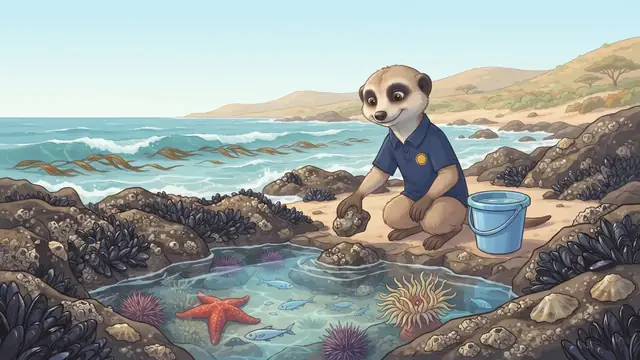
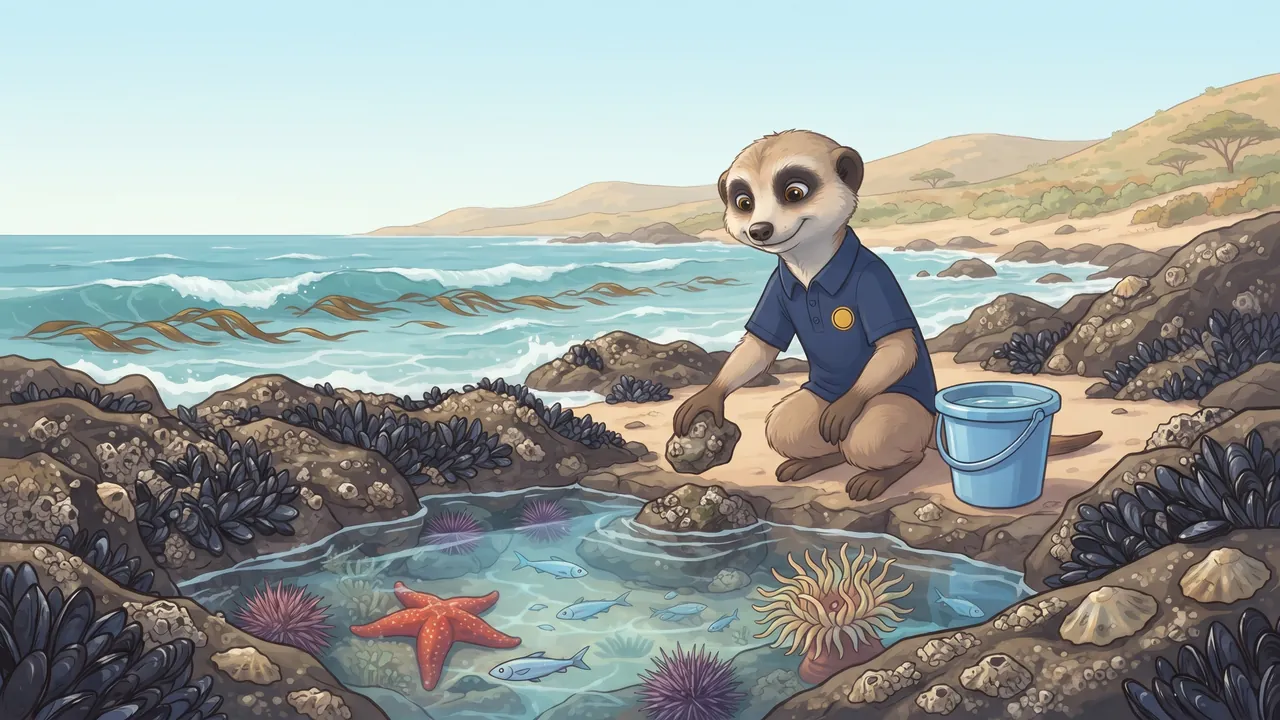
- The intertidal zone lies between the high- and low-tide marks; each zone is dry for a different time, so different organisms live there.
- Mussels and limpets shut tight or clamp on; sea anemones pull in their tentacles; crabs hide under stones.
- Seaweed’s holdfast anchors it to the rock; incoming tides bring plankton to filter feeders.
- African black oystercatchers feed at low tide, when their food is uncovered.
- Spring tides are dangerous for people fishing on rocks: the sea comes much higher than usual.
Remember this and test yourself
- Gravity is a pull between all objects with mass: bigger mass = stronger; further apart = weaker.
- The Moon affects the tides more than the Sun, because it is much closer.
- There are two tidal bulges: one towards the Moon and one on the far side. Halfway between them it is low tide.
- Two high tides are about 12 hours 25 minutes apart; high tide comes about 50 minutes later each day.
- Spring tide: Sun, Earth and Moon in a straight line. Neap tide: at first and last quarter.
Write these points in your book. Read them again the night before the test.

The Earth wears two sea bulges, like a rugby ball: one faces the Moon, one faces away. The beach turns through both: two high tides a day.
Important words
First say what the word means, then turn the card over.
Match column A to column B
Tap a word in column A, then its meaning in column B. You can also start in column B.
True or false?
Read the question and the answer. Is the answer right? Tap True or False.

Now the real quiz!
The quiz has many more questions on this topic. Every question shows straight away whether you are right and explains why.
Take the quiz: Tides, coastal ecosystems and gravity- Read one part together and ask your child to tell it back in their own words.
- The ticks (“I know this”) are saved on this device only. We never ask for names or emails.
Follows CAPS for Grade 7 Natural Sciences. Always check your teacher’s notes and textbook too.