
Biodiversity and classification
The variety of life, the five kingdoms, scientific names and why we conserve biodiversity. Read one part at a time and tap “I know this”. Then test yourself in the quiz.
Know it already? Jump straight to the quiz
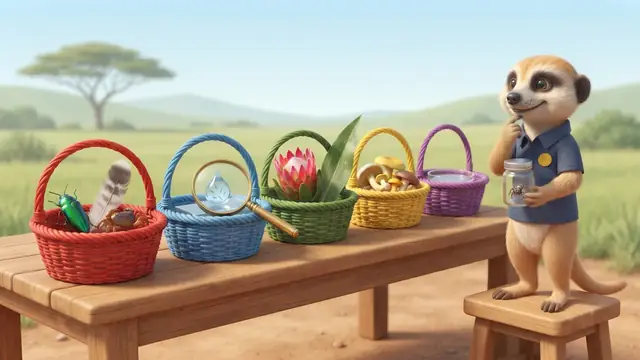
The five kingdoms
| Kingdom | Example |
|---|---|
| Animals | Lion, sea sponge |
| Plants | Protea, grass |
| Fungi | Mushroom, yeast |
| Protists | Amoeba, algae |
| Monera | Bacteria |
The largest group is the kingdom. The most important difference between a plant and an animal: plants make their own food by photosynthesis. Animals are classified by body structure and reproduction.
Plants: one or two seed leaves
| Monocotyledon (monocot) | Dicotyledon (dicot) |
|---|---|
| One seed leaf | Two seed leaves |
| Parallel veins (maize, grass) | Net-like veins (bean) |
| Fibrous roots | A main tap root |
| Flower parts in threes (lilies) | Flower parts in fours or fives (sunflower) |
Grass has small, dull flowers and lots of pollen: it is pollinated by the wind.
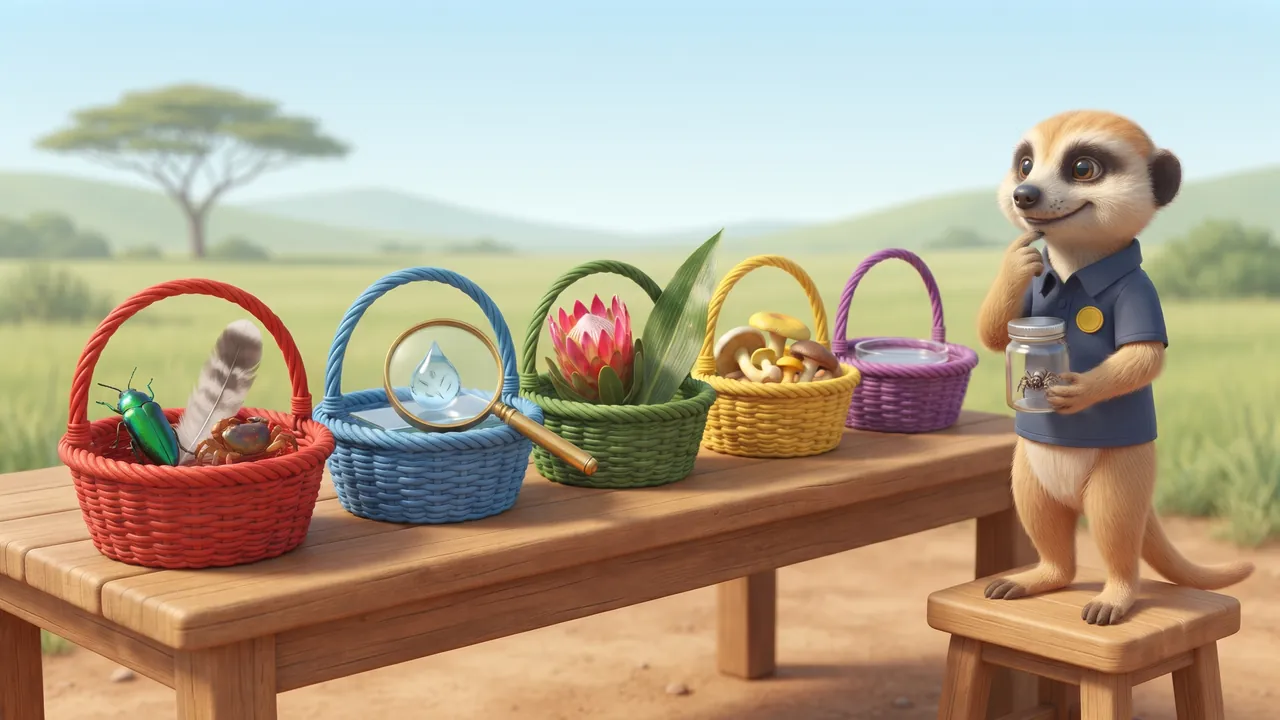
Why conserve biodiversity?
- Loss of biodiversity makes ecosystems less able to withstand change.
- The biggest cause: people destroying habitats. Alien plants crowd out native species.
- An endemic species occurs only in one region; an endangered species has very few members left.
- Ecology is the study of living things and their environment.
From kingdom to species
Scientists sort organisms into smaller and smaller groups. The members of each smaller group have more in common.
- Kingdom
- Phylum (in plants: division)
- Class
- Order
- Family
- Genus
- Species
The species is the smallest group: members of one species can have fertile young together. All people are one species: Homo sapiens.
A binomial name has two parts: the genus (with a capital letter) and the species (with a small letter), for example Homo sapiens. It is printed in italics, or underlined when you write it by hand. Carl Linnaeus invented this system.
Remember this and test yourself
- Classification orders living things by shared features.
- Five kingdoms: animals, plants, fungi, protists, monera (bacteria).
- A species is a group that can reproduce together; each has one binomial (scientific) name.
- Arthropods: insects (6 legs), arachnids (spider), crustaceans (crab).
- South Africa is rich in life because of its many climates; a seed bank saves seeds of plants at risk.
Write these points in your book. Read them again the night before the test.

Five kingdoms: A-P-F-P-M: “All Pandas Find Plenty of Mangoes.” (Animals, Plants, Fungi, Protists, Monera)
Important words
First say what the word means, then turn the card over.
Match column A to column B
Tap a word in column A, then its meaning in column B. You can also start in column B.
True or false?
Read the question and the answer. Is the answer right? Tap True or False.

Now the real quiz!
The quiz has many more questions on this topic. Every question shows straight away whether you are right and explains why.
Take the quiz: Biodiversity and classification- Read one part together and ask your child to tell it back in their own words.
- The ticks (“I know this”) are saved on this device only. We never ask for names or emails.
Follows CAPS for Grade 7 Natural Sciences. Always check your teacher’s notes and textbook too.