
Timbuktu, Mansa Musa and West African learning
Timbuktu, Mansa Musa’s pilgrimage and West African learning and manuscripts. Read one part at a time and tap “I know this”. Then test yourself in the quiz.
Know it already? Jump straight to the quiz
Trade and faith
| North to south | South to north |
|---|---|
| Salt, cloth, copper and horses | Gold, ivory and kola nuts |
Camels can go for days without water. Salt was scarce but vital in the heat. The rulers grew rich by taxing the gold and salt trade. Islam helped trade: shared faith, Arabic writing and trust. The Niger River made Mali rich through farming and transport.
Sources and decline
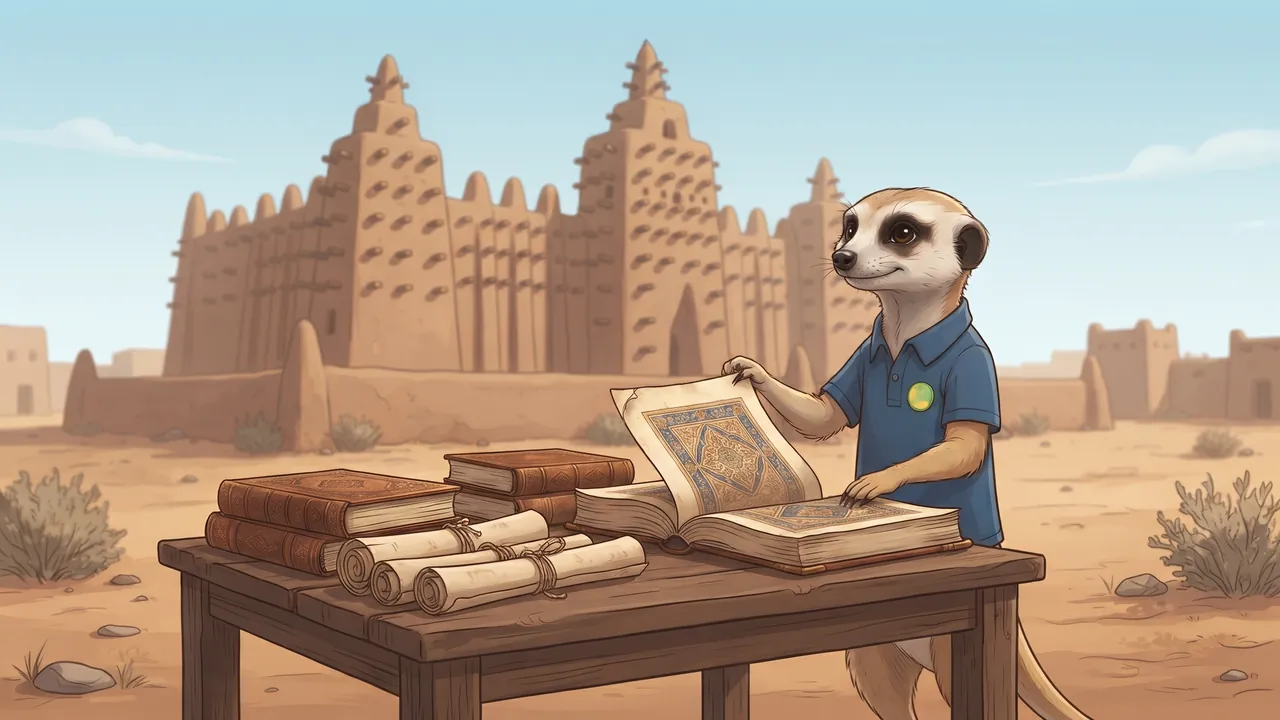
Leo Africanus visited Timbuktu around 1510, when the Songhai empire ruled it, and described it in his book Description of Africa (published in 1550). He is a primary source for Timbuktu, though not for Mali in Mansa Musa’s time. He was surprised that selling books made more profit than selling any other goods. Mali weakened in the 1400s: weak rulers, attacks and Songhai’s rise. Timbuktu is a UNESCO World Heritage Site for its old mosques.
Remember this and test yourself
- Mansa Musa set out for Mecca in 1324; in Cairo he handed out so much gold that it lost value. It showed how rich Mali was.
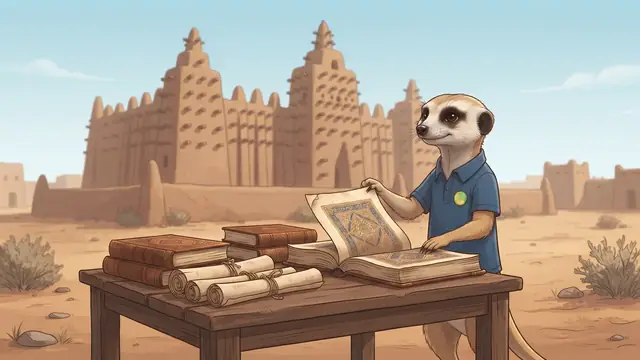
- He brought back the architect Abu Ishaq al-Sahili; the Djinguereber Mosque was built of mud (banco) and wooden beams.
- Timbuktu: where desert caravans met river boats, and a centre of learning with manuscripts on law, astronomy, medicine and maths, mostly in Arabic. The Sankore Mosque was the heart of this learning: scholars taught students there who came from across West and North Africa.
- The manuscripts prove Africa had a long writing tradition; in 2012–2013 many were smuggled to safety when militants threatened them. South Africa and Mali work together to save the manuscripts: after President Thabo Mbeki visited Timbuktu in 2001, South Africa helped train Malian conservators and raised money for a new library and archive building for the Ahmed Baba Institute, handed over to Mali in 2009.
- A griot is a storyteller who keeps oral history.
Write these points in your book. Read them again the night before the test.

In Timbuktu books earned more than other goods: it was a city of learning.
Important words
First say what the word means, then turn the card over.
Match column A to column B
Tap a word in column A, then its meaning in column B. You can also start in column B.
True or false?
Read the question and the answer. Is the answer right? Tap True or False.

Now the real quiz!
The quiz has many more questions on this topic. Every question shows straight away whether you are right and explains why.
Take the quiz: Timbuktu, Mansa Musa and West African learning- Read one part together and ask your child to tell it back in their own words.
- The ticks (“I know this”) are saved on this device only. We never ask for names or emails.
Follows CAPS for Grade 7 Social Sciences (History). Always check your teacher’s notes and textbook too.