
The Dutch and the Huguenots at the Cape
The Dutch, Huguenots and Germans at the Cape: free burghers, vineyards, Adam Tas and a lasting legacy. Read one part at a time and tap “I know this”. Then test yourself in the quiz.
Know it already? Jump straight to the quiz
The colony grows
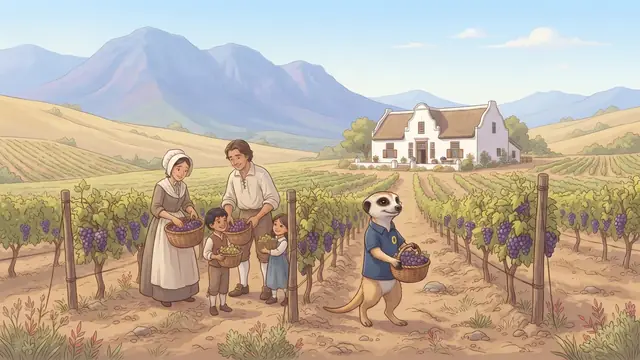
A colony is a settlement ruled by a far-away country; the VOC governed through a governor. The VOC did not want a big colony, because it cost too much. Farmers grew wheat, grapes, cattle and sheep. Free burghers were unhappy because they had to sell to the VOC at prices it set, and officials like Van der Stel competed with them. The Khoikhoi lost more and more grazing and water.
The Germans
- Many VOC soldiers and sailors came from German lands: surnames like Kruger and Muller. German did not survive, because most were single men who married Dutch-speaking women.
- Georg Schmidt started Genadendal in 1738. In the 1850s German settlers came near East London: Berlin, Hamburg, Stutterheim.
- Legacy: Afrikaans, vineyards and family names. The Huguenot Monument in Franschhoek remembers them.
Remember this and test yourself
- The VOC released the first free burghers to farm along the Liesbeek River in 1657, because the Company could not grow enough food.
- The Huguenots were French Protestants fleeing persecution (the Edict of Nantes was revoked in 1685); the first large group came in 1688 (the Voorschoten).
- They got land in Franschhoek (“French corner”) and Drakenstein (Paarl) and improved grape farming. By 1692 there were about 200.
- Simon van der Stel settled them among the Dutch burghers, so French disappeared within a few generations. Surnames: Du Toit, De Villiers.
- Adam Tas led the free burghers’ protest against Governor Willem Adriaan van der Stel in 1706.
Write these points in your book. Read them again the night before the test.

52-57-88: 1652 VOC, 1657 free burghers, 1688 Huguenots.
Important words
First say what the word means, then turn the card over.
Match column A to column B
Tap a word in column A, then its meaning in column B. You can also start in column B.
True or false?
Read the question and the answer. Is the answer right? Tap True or False.

Now the real quiz!
The quiz has many more questions on this topic. Every question shows straight away whether you are right and explains why.
Take the quiz: The Dutch and the Huguenots at the Cape- Read one part together and ask your child to tell it back in their own words.
- The ticks (“I know this”) are saved on this device only. We never ask for names or emails.
Follows CAPS for Grade 7 Social Sciences (History). Always check your teacher’s notes and textbook too.