
Cooperation and conflict on the frontier
Cooperation and conflict on the eastern frontier: land, cattle, the frontier wars and the people who played a role. Read one part at a time and tap “I know this”. Then test yourself in the quiz.
Know it already? Jump straight to the quiz
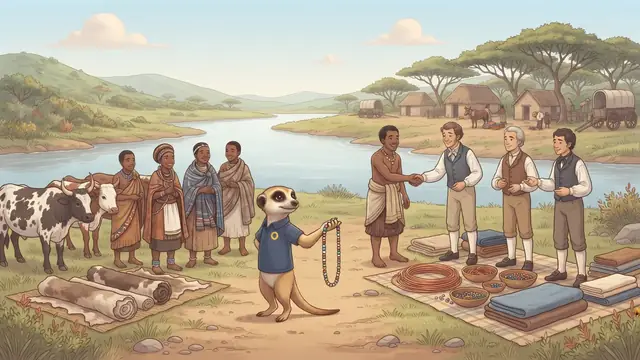
People on the frontier
| Person or group | Role |
|---|---|
| Makhanda (Nxele) | Xhosa prophet and war leader |
| Hintsa | Xhosa king during the war of 1834–1836 |
| Maqoma | Xhosa chief who resisted on the frontier |
| Andries Stockenström | Cape official who made treaties |
| Trekboers | Farmers who moved inland with their livestock for grazing and freedom |
| Johannes van der Kemp | London Missionary Society missionary on the eastern frontier (Bethelsdorp, 1803) who spoke up for Khoikhoi rights |
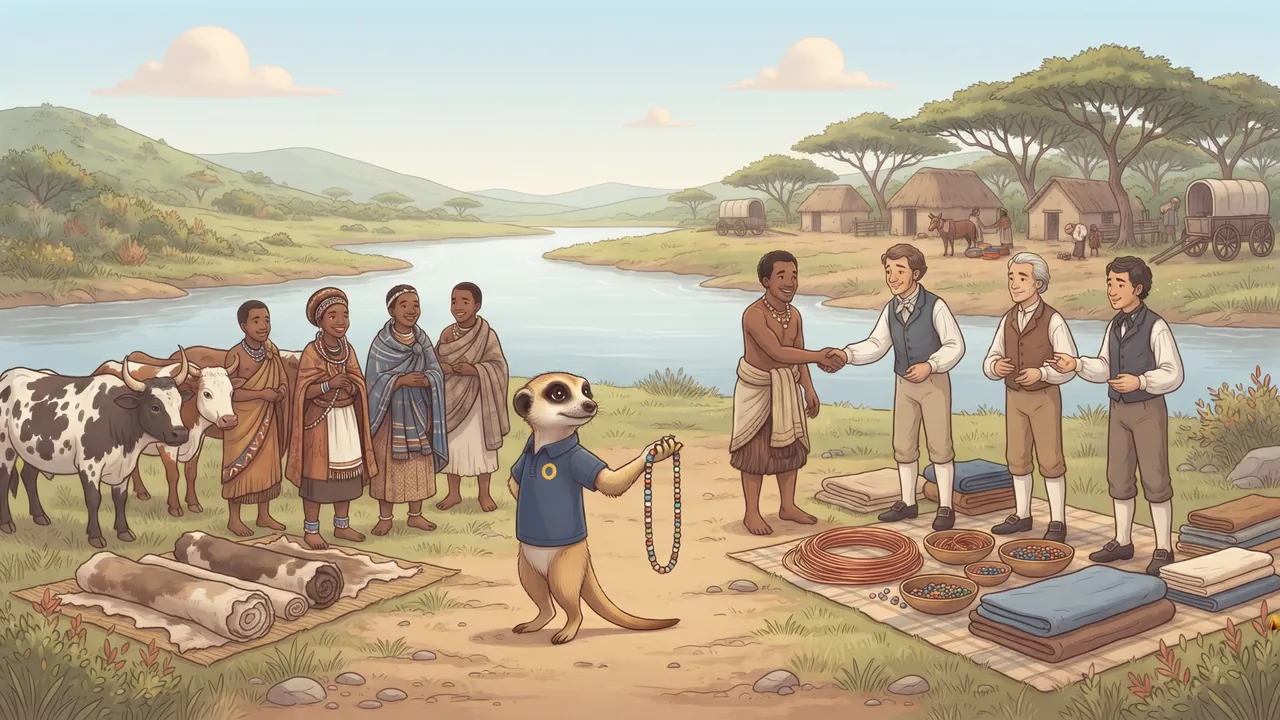
How the frontier worked
- There were nine frontier wars between 1779 and 1879. In the Fourth Frontier War (1811–1812) the Xhosa were driven out of the Zuurveld (the land west of the Fish River), and Grahamstown (today Makhanda) was founded in 1812. In 1819 Makhanda led an attack on Grahamstown that failed; afterwards the land between the Fish and Keiskamma rivers became the ‘neutral’ (Ceded) Territory.
- The ‘neutral territory’ between the Fish and Keiskamma rivers was meant to stay empty. Britain built a line of forts to control the border.
- A commando was armed farmers who joined up to fight. The Xhosa defended their land with armed resistance and negotiation. A family without cattle lost wealth and food.
- The Kat River Settlement (1829) gave land to Khoikhoi farmers. Missionaries started schools and wrote down languages.
- Land questions still matter today; the colony gained land, but at great cost.
Remember this and test yourself
- In the early 1800s the eastern frontier was around the Fish River; the Xhosa lived east of it.
- Main cause of conflict: competition for land and grazing; cattle were wealth, status and food.
- Cooperation: trade and the exchange of cattle, e.g. at the fairs at Fort Willshire.
- The series of wars are the frontier wars; the Xhosa lost land and cattle and the frontier kept shifting east.
- A treaty is an agreement between two groups; Xhosa oral sources tell their side.
Write these points in your book. Read them again the night before the test.

On the frontier there are always two sides: the market (cooperation) and the commando (conflict).
Important words
First say what the word means, then turn the card over.
Match column A to column B
Tap a word in column A, then its meaning in column B. You can also start in column B.
True or false?
Read the question and the answer. Is the answer right? Tap True or False.

Now the real quiz!
The quiz has many more questions on this topic. Every question shows straight away whether you are right and explains why.
Take the quiz: Cooperation and conflict on the frontier- Read one part together and ask your child to tell it back in their own words.
- The ticks (“I know this”) are saved on this device only. We never ask for names or emails.
Follows CAPS for Grade 7 Social Sciences (History). Always check your teacher’s notes and textbook too.