
Volcanoes, earthquakes and tectonic plates
The Earth’s layers, tectonic plates, and how volcanoes and earthquakes happen. Read one part at a time and tap “I know this”. Then test yourself in the quiz.
Know it already? Jump straight to the quiz
The Earth’s layers
- The crust is the outermost layer, up to about 60 km thick.
- The mantle lies directly below the crust: hard and semi-molten rock.
- The core is made mostly of iron and nickel and is the hottest part. The outer core is liquid (molten); the inner core is solid because of the huge pressure.
Moving plates
The crust is broken into large pieces: tectonic plates. They drift a few centimetres a year on the hot, slowly flowing rock of the mantle. Alfred Wegener proposed that the continents were once joined. The plates move because of convection currents: heat from the core makes the soft mantle rock rise, spread out, cool and sink again, in slow circles that drag the plates along.
- Where plates collide, mountains form or one plate sinks under the other.
- Where plates move apart, new crust forms.
- Where plates slide past each other, they get stuck and then suddenly jerk loose: this causes earthquakes.
- A fault line is a crack in the crust along which plates move.
Volcanoes
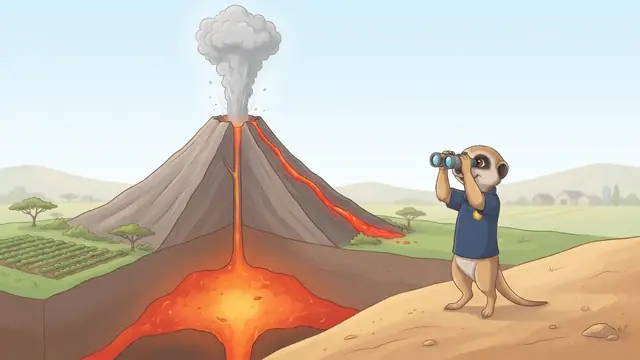
Deep under a volcano is the magma chamber. Magma rises and bursts out at the crater; above ground it is called lava. An ash cloud rises. The greatest danger is hot ash and gas rushing downhill. People still live near volcanoes, because the soil is very fertile. Magma rises where plates move apart (e.g. Iceland), where one plate sinks under another and melts (e.g. Japan and the Andes), and over hot spots in the middle of a plate (e.g. Hawaii).
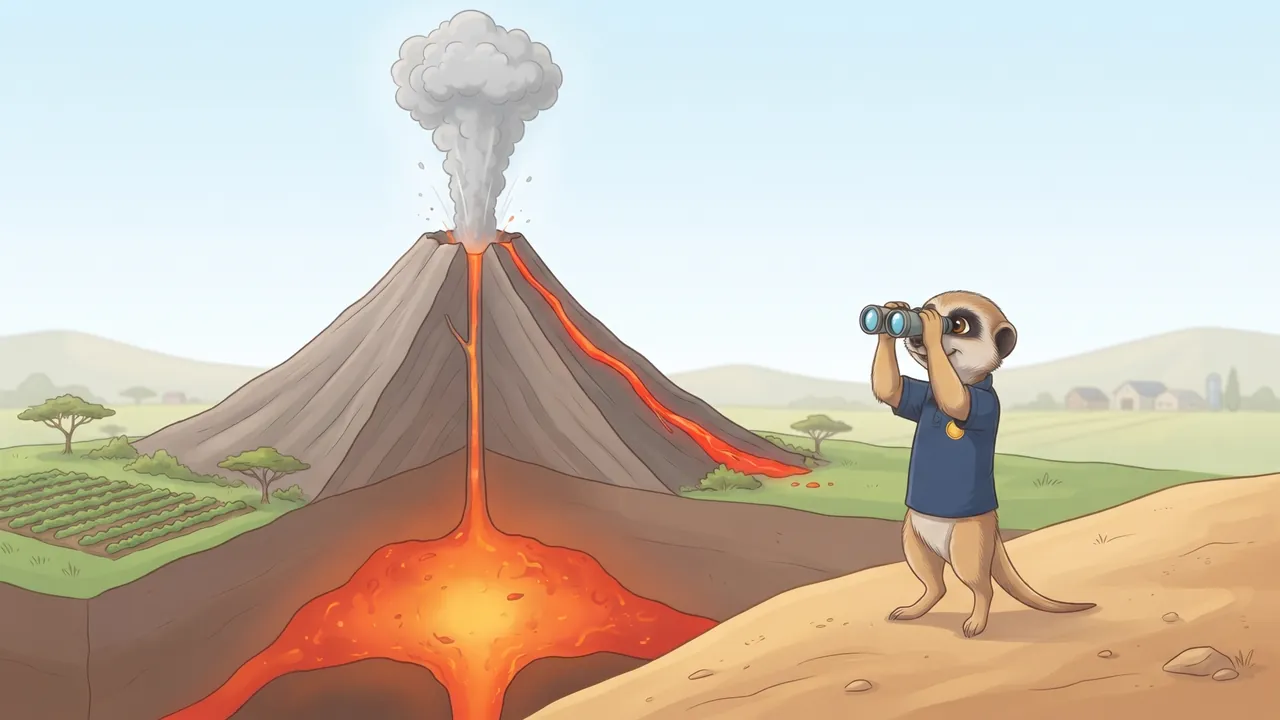

An active volcano erupts often or has erupted recently. A dormant volcano has not erupted lately but could. An extinct volcano will not erupt again. Most volcanoes lie around the Pacific Ocean.
Earthquakes
An earthquake happens when plates suddenly shift. It starts deep down at the focus; the point on the surface right above it is the epicentre, where damage is usually worst. A seismograph records the waves, and we measure the strength on the Richter scale. A big earthquake under the sea can cause a tsunami.
Indoors during an earthquake: get under a sturdy table. Plate boundaries are where both volcanoes and earthquakes happen. On a world map they form belts: the Ring of Fire around the Pacific Ocean, a line down the middle of the Atlantic Ocean, and a belt from the Mediterranean Sea to the Himalayas.
Remember this and test yourself
- The Earth has four layers: crust (up to 60 km thick), mantle, outer core and inner core.
- Tectonic plates are large pieces of crust that move a few centimetres a year on the hot mantle.
- Magma is molten rock below ground; above ground it is lava. A dormant volcano could erupt again.
- An earthquake starts at the focus; the epicentre is right above it. We measure it on the Richter scale with a seismograph.
- Volcanoes and earthquakes both happen at plate boundaries, especially around the Pacific Ocean.
Write these points in your book. Read them again the night before the test.

Magma stays underground; lava lands on top. The epicentre is on top of the focus.
Important words
First say what the word means, then turn the card over.
Match column A to column B
Tap a word in column A, then its meaning in column B. You can also start in column B.
True or false?
Read the question and the answer. Is the answer right? Tap True or False.

Now the real quiz!
The quiz has many more questions on this topic. Every question shows straight away whether you are right and explains why.
Take the quiz: Volcanoes, earthquakes and tectonic plates- Read one part together and ask your child to tell it back in their own words.
- The ticks (“I know this”) are saved on this device only. We never ask for names or emails.
Follows CAPS for Grade 7 Social Sciences (Geography). Always check your teacher’s notes and textbook too.