
Population growth and change
How populations grow and change: migration, push and pull factors, and population pyramids. Read one part at a time and tap “I know this”. Then test yourself in the quiz.
Know it already? Jump straight to the quiz
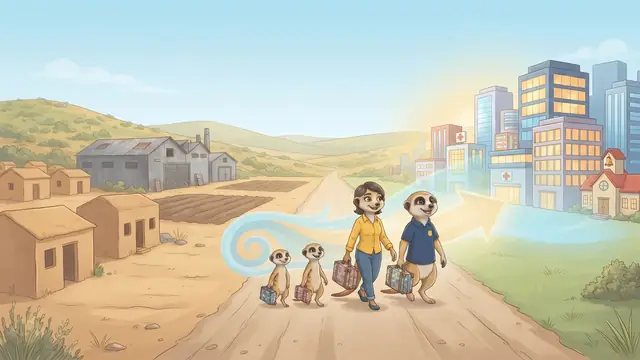
Why people move
Migration is the movement of people to another place. People move because of push factors (driving them away) and pull factors (drawing them in).
| Push factors | Pull factors |
|---|---|
| Unemployment | Work |
| Few services | Better schools and hospitals |
| War and danger (refugees) | Safety |
- Urbanisation is movement from rural areas to cities; it puts pressure on housing, water and sewerage.
- Immigration is moving into a country; emigration is moving out.
- Some people move to a small town when they retire: quieter and cheaper.
Population pyramids
A population pyramid shows how the population is split by age and sex. A wide base means many young children; a narrow base and wider top means an ageing population.

If many young adults emigrate, the young-adult bars on the pyramid get shorter.
Births, deaths and life expectancy
- The birth rate is the number of births per 1 000 people per year.
- Life expectancy is the average number of years a person can expect to live. Clean water, better food and more clinics have lengthened it.
- A high death rate together with a high birth rate gives slow growth.
- The government uses population data to plan schools and clinics. The Northern Cape is sparsely populated because of water scarcity.
Remember this and test yourself
- Population growth is the change in the number of people; a census counts everyone in a country.
- Push factors (unemployment, few services) make people leave; pull factors (work, better services) draw them.
- Immigration = moving in; emigration = moving out; refugees flee because of war or danger.
- A population pyramid shows the population by age; a wide base = many young children.
- An ageing population: fewer workers must support more people. Dependants are children and elderly people.
Write these points in your book. Read them again the night before the test.

Push factors push you out; pull factors pull you in.
Important words
First say what the word means, then turn the card over.
Match column A to column B
Tap a word in column A, then its meaning in column B. You can also start in column B.
True or false?
Read the question and the answer. Is the answer right? Tap True or False.

Now the real quiz!
The quiz has many more questions on this topic. Every question shows straight away whether you are right and explains why.
Take the quiz: Population growth and change- Read one part together and ask your child to tell it back in their own words.
- The ticks (“I know this”) are saved on this device only. We never ask for names or emails.
Follows CAPS for Grade 7 Social Sciences (Geography). Always check your teacher’s notes and textbook too.