
Population and health
How health, food and water affect population, and how the world’s population grew so fast. Read one part at a time and tap “I know this”. Then test yourself in the quiz.
Know it already? Jump straight to the quiz
Health and life expectancy
- The infant mortality rate is the number of babies per 1 000 born who do not reach age one. A high rate lowers the average life expectancy.
- Life expectancy is often higher in cities, because there are more clinics and clean water.
- Sanitation is the safe management of sewage and waste water; hand-washing removes germs.
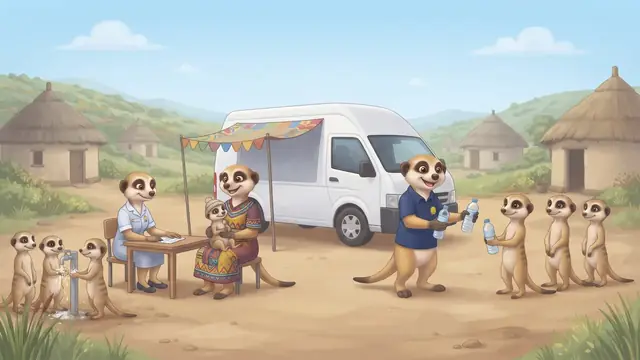
- Primary health care is basic care close to home, at a local clinic. Mobile clinics travel to remote villages.
Food and water
- Malnutrition: the body does not get the food it needs.
- A famine is a long, serious food shortage. A long drought makes crops fail and animals die.
- Food security means everyone always has enough healthy food. Irrigation, better seeds and good farming increase food production.
- Not sure if river water is safe? Boil it. In a heat wave: drink plenty of water and stay in the shade.
Dirty air from factories and coal power stations can damage lungs; road safety campaigns like Arrive Alive lower the death rate.
Why the population grew so fast
| Invention or change | Effect |
|---|---|
| Seed drill (1700s) | Seeds in neat rows: more food |
| Crop rotation | A different crop each year: healthier soil |
| Clean piped water and sewers (1800s) | Fewer people ill, fewer deaths |
| Refrigeration | Food stays fresh longer |
| Green Revolution (1950s–60s) | New seeds, fertilisers and irrigation: bigger harvests |

Where girls get an education, families usually have fewer children. If the death rate falls sharply while the birth rate stays high, the population grows quickly.
Diseases and the growth of the world’s population
- Diseases such as TB, malaria and diarrhoea raise the death rate, especially where there is little clean water and few clinics.
- Pandemics of the past: the Black Death (1347–1351) killed about one third of Europe’s people, and a smallpox epidemic at the Cape in 1713 hit the Khoikhoi hard. The Spanish flu (1918–1919) killed about 50 million people worldwide; in South Africa about 300 000 people died in only about six weeks.
- Economic status, family needs and beliefs, war and government policy (such as China’s policy of one child per family) also affect birth and death rates.
| Year | World population (about) |
|---|---|
| AD 1 | 300 million |
| 1800 | 1 billion |
| 1927 | 2 billion |
| 2022 | 8 billion |
On a line graph the growth looks flat at first and then shoots up: more food, better sanitation, vaccination, canned and frozen food and better health care made the death rate fall.
Remember this and test yourself
- Infant mortality rate: babies per 1 000 born who do not reach age one. Clean water, healthy food and clinics lower it.
- Primary health care is basic care close to home; mobile clinics reach remote villages.
- Malnutrition: the body does not get the food it needs; a famine is a long, serious food shortage.
- Food security: everyone always has enough healthy food.
- Population grew fast thanks to better medicine, clean water and more food (seed drill, crop rotation, the Green Revolution, refrigeration).
Write these points in your book. Read them again the night before the test.

Three things that make lives longer: clean water, enough food, a clinic nearby.
Important words
First say what the word means, then turn the card over.
Match column A to column B
Tap a word in column A, then its meaning in column B. You can also start in column B.
True or false?
Read the question and the answer. Is the answer right? Tap True or False.

Now the real quiz!
The quiz has many more questions on this topic. Every question shows straight away whether you are right and explains why.
Take the quiz: Population and health- Read one part together and ask your child to tell it back in their own words.
- The ticks (“I know this”) are saved on this device only. We never ask for names or emails.
Follows CAPS for Grade 7 Social Sciences (Geography). Always check your teacher’s notes and textbook too.