
Water: purification and water resources
How river water becomes clean drinking water, our water resources, and how we save water. Read one part at a time and tap “I know this”. Then test yourself in the quiz.
Know it already? Jump straight to the quiz
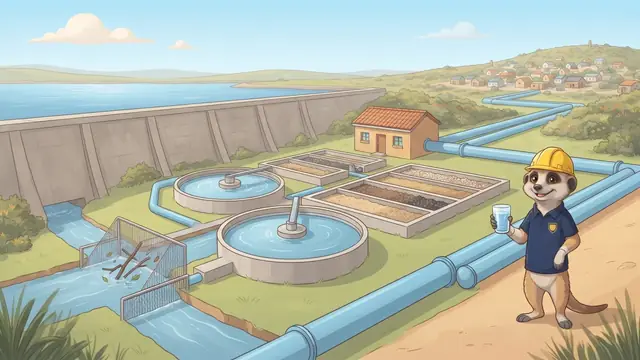
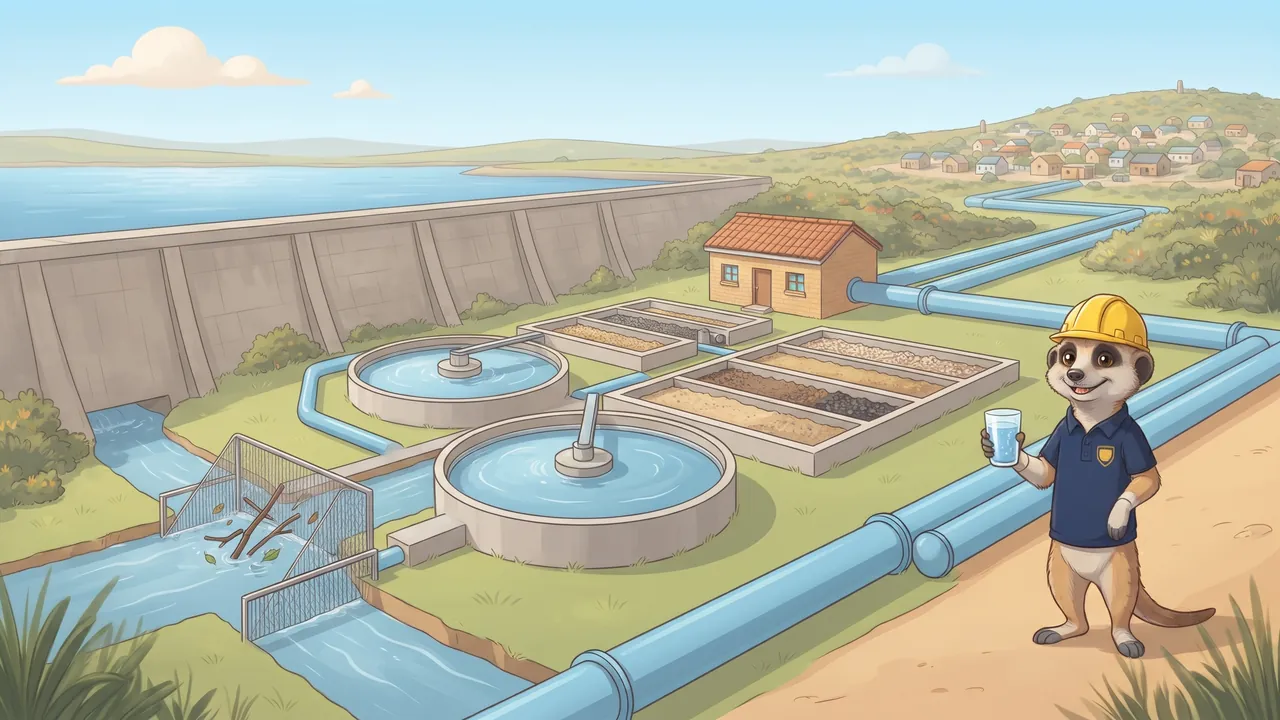
From river to tap
First sticks and rubbish are screened out. Then heavy particles sink to the bottom (sedimentation). A filter of sand and gravel traps the small bits. Finally chlorine kills the remaining germs. Germs are far too small to see.
Our water resources
| Word | Meaning |
|---|---|
| Water resource | A river, dam or borehole |
| Groundwater | Water held underground in soil and rock |
| Sewage | Dirty water from toilets and kitchens; cleaned at a waste-water works |
| Desalination | Removing salt from sea water |
| Grey water | Used water from baths and basins |
Polluted water
| Insoluble pollution | Soluble pollution |
|---|---|
| Oil, plastic, old tyres | Soap and cleaning products |
| Cans, glass | Fertiliser, pesticides, acids |
You can see and remove insoluble pollution; soluble pollution mixes with the water and is much harder to remove. If sewage ends up in a river, the water carries germs that cause diseases such as diarrhoea and cholera. That is why the municipality cleans water before we drink it, and again after we have used it, at the waste-water works, before it goes back to the river.
Protect our water
- Farm chemicals wash into rivers and pollute them.
- Litter in a stormwater drain washes into rivers and harms animals.
- Wetlands work like a sponge: they hold water, filter out dirt and slow floods. They are also a home for many plants and animals (biodiversity).
- A school can fix leaks and catch rainwater.
- When wetlands are drained or built on, plants and animals lose their homes, the water downstream becomes dirtier and floods get worse.
- Build a simple sand filter: a cut-off bottle with layers of pebbles, coarse sand and fine sand. It traps dirt, but not germs: still boil the water before you drink it.
Remember this and test yourself
- River water may carry germs and dirt; clear water can still be unsafe.
- Purifying: screen → settle → filter → disinfect (chlorine). At home: boil it.
- Potable water is safe to drink.
- South Africa is water-scarce: low and uneven rain. Farming uses the most water.
- Fix a dripping tap; catch rainwater; use grey water.
Write these points in your book. Read them again the night before the test.

S-S-F-D: Screen, Settle, Filter, Disinfect: “Super Safe Fresh Drinks.”
Important words
First say what the word means, then turn the card over.
Match column A to column B
Tap a word in column A, then its meaning in column B. You can also start in column B.
True or false?
Read the question and the answer. Is the answer right? Tap True or False.

Now the real quiz!
The quiz has many more questions on this topic. Every question shows straight away whether you are right and explains why.
Take the quiz: Water: purification and water resources- Read one part together and ask your child to tell it back in their own words.
- The ticks (“I know this”) are saved on this device only. We never ask for names or emails.
Follows CAPS for Grade 6 Natural Sciences and Technology. Always check your teacher’s notes and textbook too.