
Food processing and preserving
Why food goes bad, how we process and preserve food, and how to handle food safely. Read one part at a time and tap “I know this”. Then test yourself in the quiz.
Know it already? Jump straight to the quiz
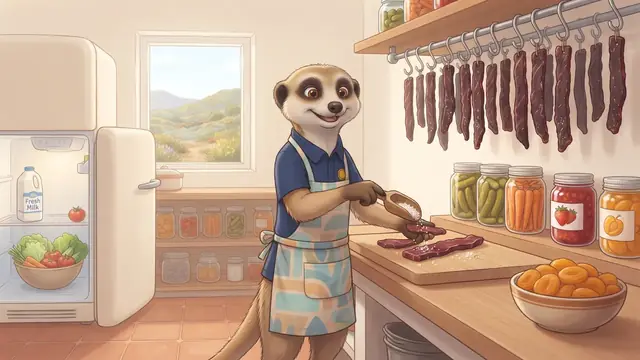
Preserving methods
| Method | How it works | Example |
|---|---|---|
| Drying | Removes the water germs need | Dried fruit, biltong |
| Salting | Salt draws out the water | Salted fish, biltong |
| Canning | Heated and sealed airtight | Tins of beans |
| Freezing | Cold stops germs multiplying | Frozen peas |
| Pasteurising | Heats to kill harmful germs | Milk |
| Pickling | In vinegar or brine | Atchar, pickles |
| Adding sugar | A lot of sugar draws out the water, so germs cannot grow | Jam |
| Smoking | Smoke and slow heat dry the food and help stop germs | Smoked fish, smoked meat |

Why do we process food?
We process food for three reasons: to make it edible (raw maize meal and dry beans must be cooked), to preserve it so that it lasts longer, and to make it more nutritious or tastier.
| Method | What happens | Example |
|---|---|---|
| Cooking | Heat softens food and kills germs | Pap, rice, beans |
| Fermenting | Useful micro-organisms change the food: it lasts longer and becomes more nutritious | Maas, mageu, bread (yeast makes the dough rise) |
| Traditional drying | Sun and wind take the water out | Biltong, dried mealies |
People in South Africa have processed food in their own ways for centuries, long before factories: meat becomes biltong, mealies dry in the sun, and milk turns into maas in a calabash.
Processed or fresh?
- Milling turns wheat into flour; milk becomes cheese.
- A fresh carrot is unprocessed.
- A preservative is added so that food lasts longer.
- A lot of processed food has added salt, sugar and fat, and some vitamins are lost.
People preserved food long before fridges, to have food in seasons when little grows. Labels list the ingredients, so people know what is in the food.
Safe with food
- Wash your hands before handling food: hygiene stops germs.
- Keep raw meat away from cooked food.
- Do not use a swollen or badly dented tin: the seal may be broken.
- Do not refreeze food that has thawed: germs multiply while it is warm.
Remember this and test yourself
- Food goes bad because of micro-organisms such as bacteria and moulds.
- Drying and salting remove the water germs need (biltong!).
- Canning: heated and sealed airtight. Freezing and the fridge stop or slow germs.
- Pasteurising: heating milk to kill germs. Pickling: in vinegar or brine.
- “Use by” is about safety; “best before” is about quality.
Write these points in your book. Read them again the night before the test.

Germs need water, warmth and time. Drying takes the water, cold takes the warmth, canning locks them out.
Important words
First say what the word means, then turn the card over.
Match column A to column B
Tap a word in column A, then its meaning in column B. You can also start in column B.
True or false?
Read the question and the answer. Is the answer right? Tap True or False.

Now the real quiz!
The quiz has many more questions on this topic. Every question shows straight away whether you are right and explains why.
Take the quiz: Food processing and preserving- Read one part together and ask your child to tell it back in their own words.
- The ticks (“I know this”) are saved on this device only. We never ask for names or emails.
Follows CAPS for Grade 6 Natural Sciences and Technology. Always check your teacher’s notes and textbook too.