
Sound: vibration, pitch and loudness
Vibration, pitch and loudness, and how the ear sends sound to the brain. Read one part at a time and tap “I know this”. Then test yourself in the quiz.
Know it already? Jump straight to the quiz

High and low
| High pitch | Low pitch |
|---|---|
| Short straw | Long straw |
| Thin guitar string | Thick guitar string |
| String tightened | String looser |
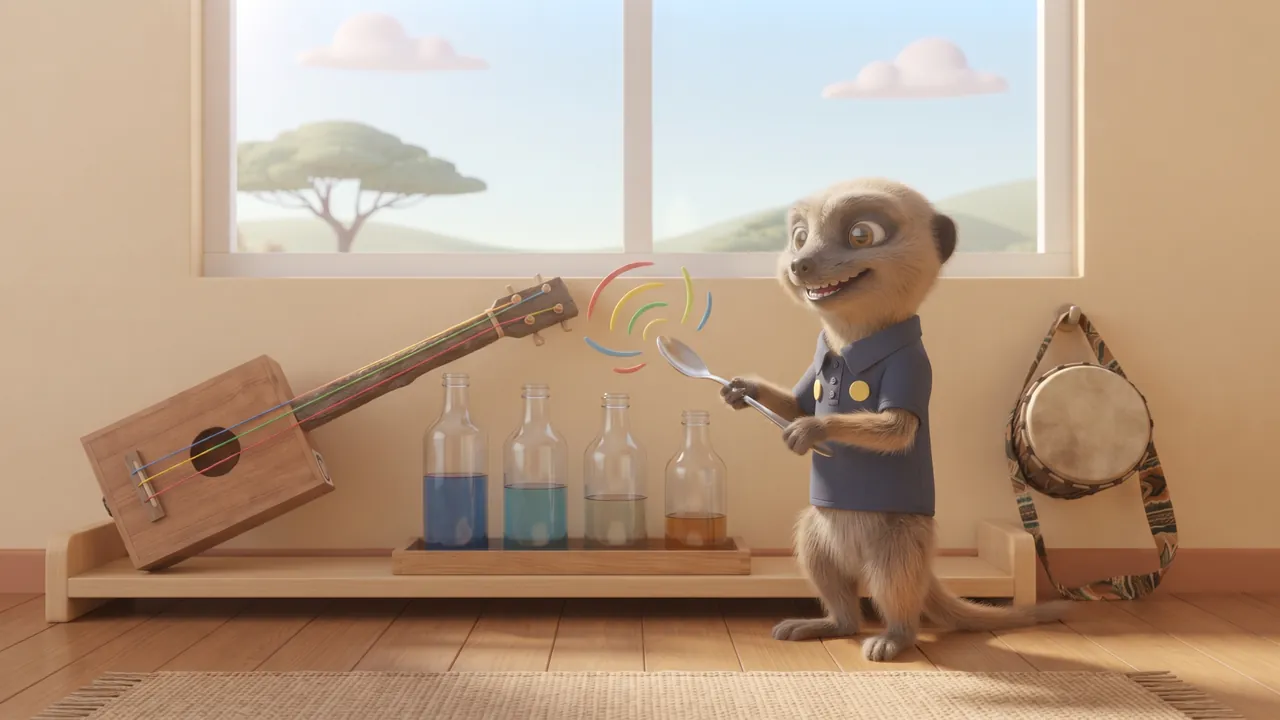
| Bottle with little water (tap) | Bottle with lots of water (tap) |
| A bird chirping | A big bass drum |
Fast vibrations = high sound. Slow vibrations = low sound.
If you blow across the top of the bottles instead, the bottle with the most water gives the highest sound, because there is less air to vibrate.
Loud and soft
Big vibrations make a loud sound; small vibrations a soft sound. Rustling leaves are soft. Very loud sounds can damage your hearing, so workers at machines wear ear protectors.
- To make a sound louder or carry further: hit, pluck or blow harder (bigger vibrations).
- Cup your hands around your mouth, or speak through a cone (megaphone): the sound then goes in one direction.
- A hollow box or calabash that vibrates too makes the sound louder, like a guitar’s body or the uhadi’s calabash.
- A loudspeaker makes sound much louder.
A string telephone only works when the string is tight: the vibrations travel along the string.
How we hear
The outer ear collects the sound. The eardrum starts to vibrate, and three tiny bones pass the vibration on. The cochlea looks like a snail shell and is full of liquid. A nerve sends signals to the brain, and that is where we really ‘hear’.

The Karoo’s bat-eared fox hears the soft sounds of insects underground with its big ears.
Remember this and test yourself
- Something must vibrate to make a sound.
- Pitch is how high or low a sound is: short, thin and tight gives a high sound.
- Loudness depends on how big the vibrations are; we measure it in decibels (dB).
- Sound travels through air, water and solids, but not through empty space.
- The path through the ear: outer ear → ear canal → eardrum → three tiny bones → cochlea → nerve → brain.
Write these points in your book. Read them again the night before the test.

Short, Thin, Tight = high like a little bird. Long, thick, loose = low like a bass drum.
Important words
First say what the word means, then turn the card over.
Match column A to column B
Tap a word in column A, then its meaning in column B. You can also start in column B.
True or false?
Read the question and the answer. Is the answer right? Tap True or False.

Now the real quiz!
The quiz has many more questions on this topic. Every question shows straight away whether you are right and explains why.
Take the quiz: Sound: vibration, pitch and loudness- Read one part together and ask your child to tell it back in their own words.
- The ticks (“I know this”) are saved on this device only. We never ask for names or emails.
Follows CAPS for Grade 4 Natural Sciences and Technology. Always check your teacher’s notes and textbook too.