
Animal groups in depth
Cold- and warm-blooded animals, invertebrate groups, and the five vertebrate classes up close. Read one part at a time and tap “I know this”. Then test yourself in the quiz.
Know it already? Jump straight to the quiz

Warm and cold
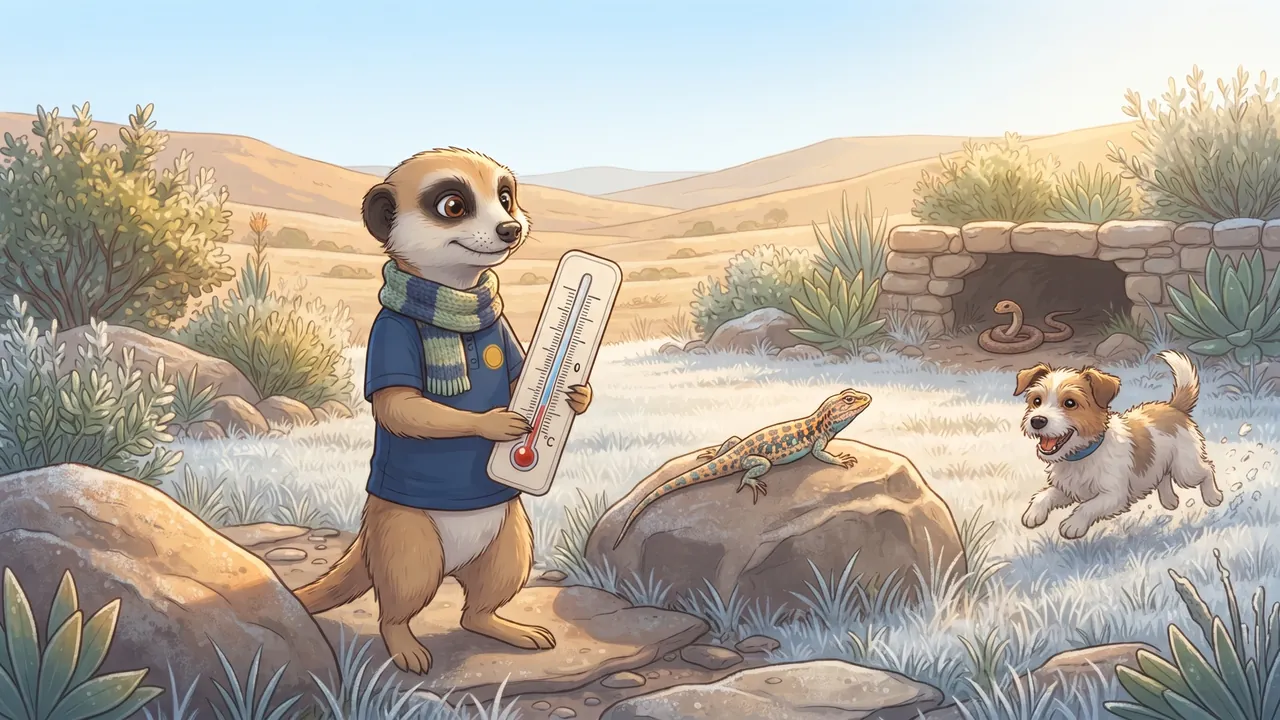
In winter a dog stays warm, but a snake becomes slow: the snake is cold-blooded. A lizard lies in the sun in the morning to get going. Insects must moult, because their hard exoskeleton cannot grow.
Invertebrates
| Group | Feature | Example |
|---|---|---|
| Insects | 3 body parts, 6 legs | Beetle, bee |
| Arachnids | 2 body parts, 8 legs | Spider, scorpion |
| Crustaceans | Hard shell; mostly in water | Crab, prawn, crayfish |
| Myriapods | Very many legs | Millipede |
| Molluscs | Soft body, often a shell | Snail, octopus |
| Worms | Long soft body | Earthworm |
Comparing vertebrates
- Fish live in water, breathe with gills, have fins and usually scales, are cold-blooded and mostly lay eggs in water.
- Frogs are amphibians: they live in water and on land; tadpoles breathe with gills.
- Only birds have feathers; only mammals feed their young milk.
- Reptiles: dry, scaly skin and eggs with leathery shells.
- Birds and mammals: both warm-blooded vertebrates with lungs.
The first question to classify an animal: does it have a backbone?
Remember this and test yourself
- Cold-blooded (ectothermic): body temperature changes with the surroundings (air or water). Warm-blooded (endothermic): stays steady.
- An insect has three body parts (head, thorax, abdomen) and 6 legs; a spider two and 8 legs.
- Molluscs: snails, octopuses. Crustaceans: crabs, prawns. Myriapods: many legs.
- About 95% of all animal species are invertebrates.
- A whale is a mammal: it breathes air and feeds its young milk. A sea turtle is a reptile.
Write these points in your book. Read them again the night before the test.

Insect: 3 parts, 6 legs (“3 × 2”). Spider: 2 parts, 8 legs. Count the legs and you know the group.
Important words
First say what the word means, then turn the card over.
Match column A to column B
Tap a word in column A, then its meaning in column B. You can also start in column B.
True or false?
Read the question and the answer. Is the answer right? Tap True or False.

Now the real quiz!
The quiz has many more questions on this topic. Every question shows straight away whether you are right and explains why.
Take the quiz: Animal groups in depth- Read one part together and ask your child to tell it back in their own words.
- The ticks (“I know this”) are saved on this device only. We never ask for names or emails.
Follows CAPS for Grade 7 Natural Sciences. Always check your teacher’s notes and textbook too.