
Pre-colonial economies of the semi-arid societies
Pre-colonial economies of the dry interior: herders and hunter-gatherers, exchange, copper and rain. Read one part at a time and tap “I know this”. Then test yourself in the quiz.
Know it already? Jump straight to the quiz
Who and what
| Group or item | Importance |
|---|---|
| The ǀXam San (Karoo) | Left many rock engravings |
| The Nama (Namaqualand) | Mined and worked copper |
| Specularite (sibilo) | A shiny mineral to decorate the body |
| Ostrich-eggshell beads | Widely traded; shells were also buried to store water |
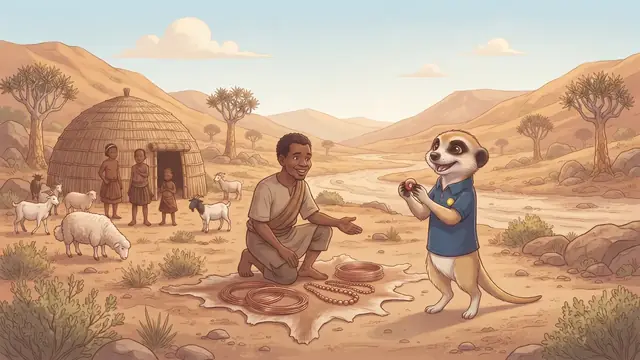
Copper and iron were traded for cattle, beads and skins. A wealthy person in a herding society owned many animals, but drought or raids could quickly destroy a herd. Rainmaking mattered, because rain decided whether people and herds survived.
Living together
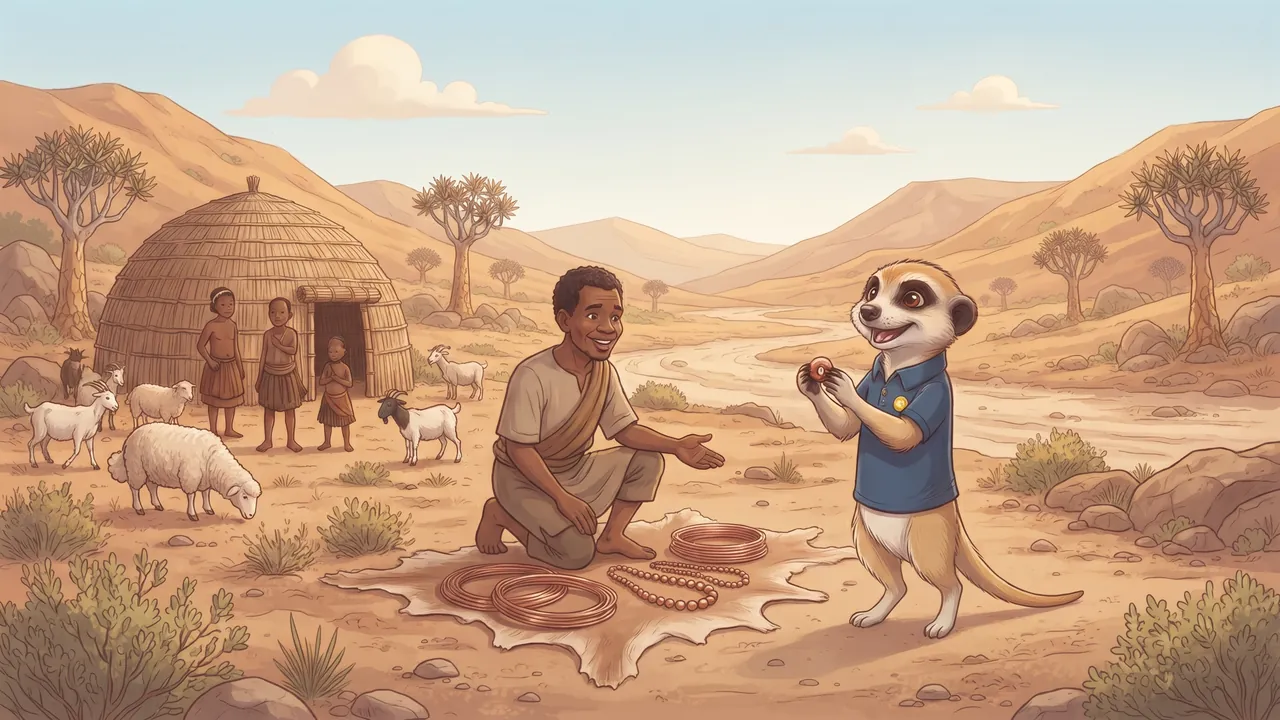
- Herders and hunter-gatherers swapped food, skins, skills and work; friction arose when herds ate the grass that wild game needed.
- They governed through family heads and chiefs, by discussion. Knowledge was passed on by speaking, so there are few written records; archaeologists use bones, pottery, beads and stone tools. Pottery suggests new ways to cook and store food.
Remember this and test yourself
- Semi-arid: dry, with low and unreliable rain; crops were hard. People hunted and gathered, or herded.
- Sheep and goats (later cattle) suited dry country best. Transhumance: moving herds with the seasons.
- Herders spread their animals over several places to lower the risk; lending cattle built a lasting bond between families.
- Hxaro: San gift-giving that builds lasting partnerships, so partners far away could help in a drought.
- The Cape settlement badly damaged these economies: settlers took the best grazing and water.
Write these points in your book. Read them again the night before the test.

In a dry land friends are your insurance: share today, get help in the drought.
Important words
First say what the word means, then turn the card over.
Match column A to column B
Tap a word in column A, then its meaning in column B. You can also start in column B.
True or false?
Read the question and the answer. Is the answer right? Tap True or False.

Now the real quiz!
The quiz has many more questions on this topic. Every question shows straight away whether you are right and explains why.
Take the quiz: Pre-colonial economies of the semi-arid societies- Read one part together and ask your child to tell it back in their own words.
- The ticks (“I know this”) are saved on this device only. We never ask for names or emails.
Follows CAPS for Grade 7 Social Sciences (History). Always check your teacher’s notes and textbook too.