
Colonisation of the Cape
The VOC at the Cape: the refreshment station, the free burghers, slavery and the consequences for the Khoikhoi. Read one part at a time and tap “I know this”. Then test yourself in the quiz.
Know it already? Jump straight to the quiz
From post to colony
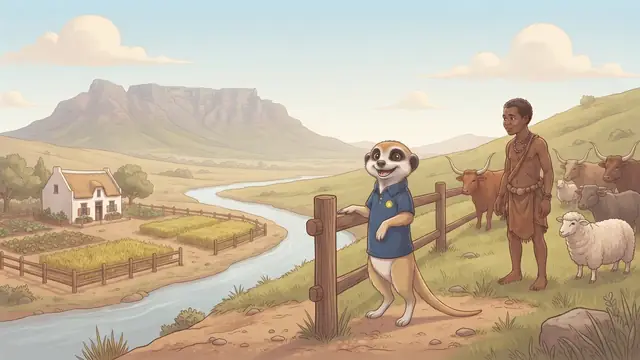
- In 1660 Van Riebeeck planted a hedge of wild almonds as a border with the Khoikhoi. Simon van der Stel founded Stellenbosch.
- The VOC planted vegetables and fruit for ships. Bartering: swapping goods without money.
Slavery and language
The VOC imported enslaved labour because workers were needed and the Khoikhoi refused. Enslaved people did farm, domestic and trade work; the Company’s slaves were housed in the Slave Lodge in Cape Town. An enslaved person who gained freedom is a freed person. Afrikaans grew out of contact between people at the Cape. 1652 is a contested date: history does not begin there.
Remember this and test yourself
- The VOC (Dutch East India Company) founded a refreshment station in 1652 under Jan van Riebeeck to supply ships with fresh food.
- The Cape was halfway to the East, with fresh water; Van Riebeeck’s ships: Drommedaris, Reijger and Goede Hoop. First building: a fort.
- The Khoikhoi and San already lived there; the Khoikhoi lost grazing land and cattle (war in 1659).
- Free burghers: VOC employees allowed to farm, but they could sell only to the VOC, at fixed prices.
- Enslaved people from Madagascar, India, the East Indies (Indonesia), East Africa (Mozambique) and, at first, West Africa: a society founded on inequality. The first large groups of enslaved people arrived in 1658 on the ships Amersfoort and Hasselt.
Write these points in your book. Read them again the night before the test.

1652: a kitchen for ships (refreshment station) that became a colony.
Important words
First say what the word means, then turn the card over.
Match column A to column B
Tap a word in column A, then its meaning in column B. You can also start in column B.
True or false?
Read the question and the answer. Is the answer right? Tap True or False.

Now the real quiz!
The quiz has many more questions on this topic. Every question shows straight away whether you are right and explains why.
Take the quiz: Colonisation of the Cape- Read one part together and ask your child to tell it back in their own words.
- The ticks (“I know this”) are saved on this device only. We never ask for names or emails.
Follows CAPS for Grade 7 Social Sciences (History). Always check your teacher’s notes and textbook too.