
Needs, resources and production
Needs and wants, scarcity and opportunity cost, and the four factors of production. Read one part at a time and tap “I know this”. Then test yourself in the quiz.
Know it already? Jump straight to the quiz
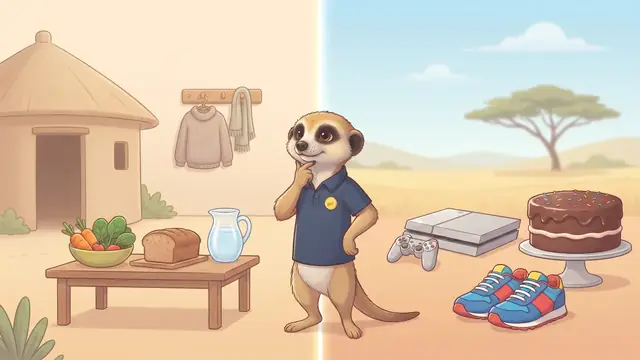
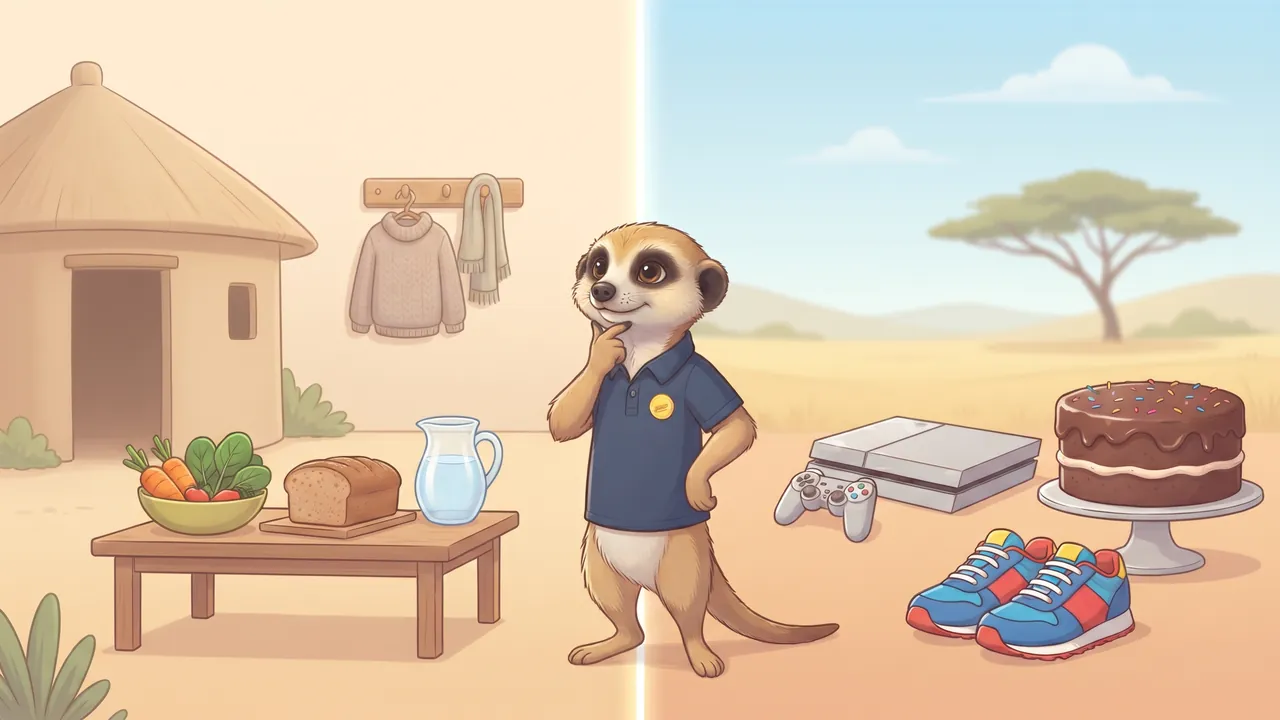
Needs, wants and scarcity
| Need (essential) | Want (not essential) |
|---|---|
| Food and clean water | A new cellphone |
| Shelter (a home) | Branded takkies |
| Clothes for the weather | A games console |
| Education and health care (secondary needs) | A holiday at the sea |
Primary needs keep us alive: food, water, shelter and clothing. Secondary needs make life better but are not needed to survive: education, health care, transport and communication. A community needs schools, clinics and roads; a country needs things like electricity, police and defence.
Nobody can satisfy all their wants, because resources are limited: that is scarcity. When a resource becomes scarcer, the price usually rises. Thandi uses her savings for a school trip instead of new takkies: the takkies are her opportunity cost.
The four factors of production
| Factor | What it is | Example in a bakery |
|---|---|---|
| Natural resources | Land, water, minerals | Water, and the land the bakery stands on |
| Labour | People’s work | The bakers |
| Capital | Tools, machines and money | The oven and mixer |
| Entrepreneurship | The ability to start and run a business | The owner |
What we produce is goods (things, like bread) and services (work done for someone, like a dentist visit). A producer makes goods or provides services; the consumer buys and uses them. A household is a consumer when it buys food and clothes, and a producer when its members work for a business (labour) or grow vegetables. Workers specialise in a factory, so work goes faster and better.
- Consumable goods are used up, like bread.
- Durable goods last a long time, like a fridge.
- Capital goods are used to make other goods, like an oven.
The three sectors
- Primary: mining, farming, fishing.
- Secondary: a furniture factory, a bread factory.
- Tertiary: a bank, a plumber, a shop.
In a subsistence economy people make just enough for their own needs. Public goods such as roads are provided by the state for everyone.
Remember this and test yourself
- A need is essential: primary needs (food, water, shelter, clothing) keep us alive; secondary needs (education, health care) make life better. A want is nice to have (a new phone).
- Scarcity: resources are limited, but wants are unlimited.
- Opportunity cost: what you give up when you choose one thing over another.
- Four factors of production: natural resources, labour, capital and entrepreneurship.
- Three sectors: primary (nature), secondary (factories), tertiary (services).
Write these points in your book. Read them again the night before the test.

Need = I cannot do without it. Want = it would be nice. And four factors: “Never Let Cats Escape” (natural resources, labour, capital, entrepreneurship).
Important words
First say what the word means, then turn the card over.
Match column A to column B
Tap a word in column A, then its meaning in column B. You can also start in column B.
True or false?
Read the question and the answer. Is the answer right? Tap True or False.

Now the real quiz!
The quiz has many more questions on this topic. Every question shows straight away whether you are right and explains why.
Take the quiz: Needs, resources and production- Read one part together and ask your child to tell it back in their own words.
- The ticks (“I know this”) are saved on this device only. We never ask for names or emails.
Follows CAPS for Grade 7 Economic and Management Sciences (EMS). Always check your teacher’s notes and textbook too.