
Democracy and citizenship
Democracy in South Africa: elections, the Constitution, government and being a good citizen. Read one part at a time and tap “I know this”. Then test yourself in the quiz.
Know it already? Jump straight to the quiz
How it works
| Who or what | Job |
|---|---|
| Parliament (Cape Town) | Makes the country’s laws |
| Premier | Leads a province’s government |
| Local municipality | Water and refuse removal |
| Public Protector | Investigates misuse of state power |
| Free press | Holds the government to account |
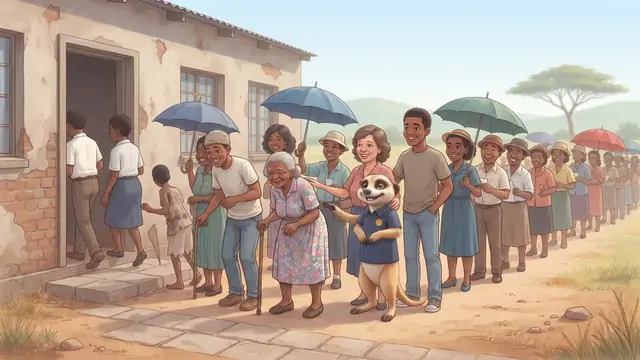
In the first democratic election (27 April 1994) all adults, of every race, could vote for the first time. The ANC won the most votes. The first democratic government was a Government of National Unity: ministers from more than one party governed together.

A good citizen
- Respect others and contribute. More than one party gives voters a real choice.
- The Bill of Rights guarantees everyone’s basic rights, like freedom of speech; a peaceful march is a protest.
- National symbols like the flag bind the people together.
Write a biography
A biography is a person’s life story, written by someone else.
- Choose a South African who helped to build our democracy.
- Find sources: books, reliable websites, newspapers, and talk to people who knew the person.
- Make notes: birth, childhood, school, important events, challenges, and why the person matters.
- Arrange the facts on a timeline.
- Write in the third person (he or she) and in the past tense, from beginning to end.
- List your sources at the end.
Everyone is equal before the law: even the president must obey the law.
Remember this and test yourself
- Democracy: the people choose the government; the first democratic election was in 1994 (Freedom Day, 27 April). On 10 May 1994 Nelson Mandela became the first democratically elected president.
- A dictatorship: one person holds all the power.
- Vote at 18; nobody may watch how you vote; make a cross (X) next to your choice.
- The Constitution is the highest law; the Constitutional Court is the highest court and can strike down a law that clashes with it.
- The president serves at most two five-year terms and is elected by the National Assembly.
Write these points in your book. Read them again the night before the test.

Demo = people, cracy = power: power to the people.
Important words
First say what the word means, then turn the card over.
Match column A to column B
Tap a word in column A, then its meaning in column B. You can also start in column B.
True or false?
Read the question and the answer. Is the answer right? Tap True or False.

Now the real quiz!
The quiz has many more questions on this topic. Every question shows straight away whether you are right and explains why.
Take the quiz: Democracy and citizenship- Read one part together and ask your child to tell it back in their own words.
- The ticks (“I know this”) are saved on this device only. We never ask for names or emails.
Follows CAPS for Grade 6 Social Sciences (History). Always check your teacher’s notes and textbook too.