
Why people live where they do
Why people live where they do, rural and urban, and what urbanisation is. Read one part at a time and tap “I know this”. Then test yourself in the quiz.
Know it already? Jump straight to the quiz
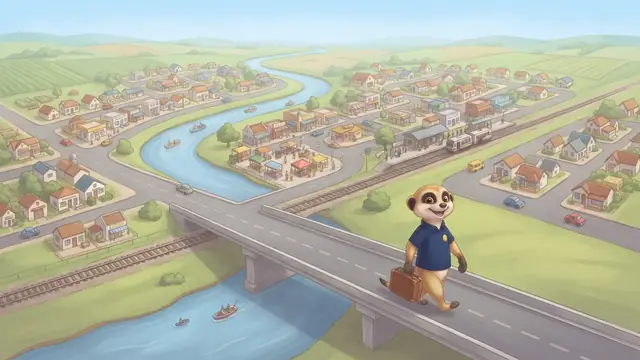
Why people live here
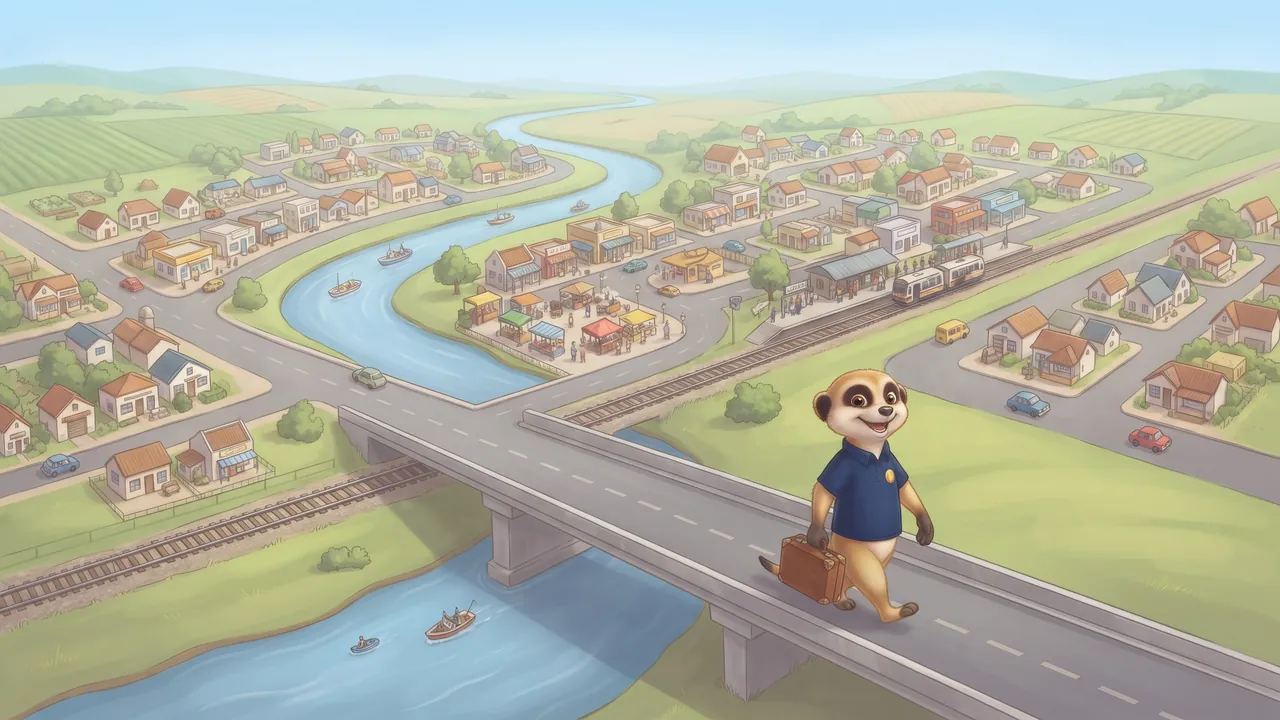
- Water: everyone needs water, so early settlements formed near rivers.
- Transport: towns grow at crossroads and railways, because transport brings trade.
- River crossings: travellers crossed the river there.
- Work: a town near a mine grows quickly. Kimberley grew around a diamond mine; gold drew people to Gauteng, far inland.
Dense or sparse
Population distribution is how people are spread out over an area: where many and where few people live. A distribution map shows it with dots or colours. Population density is the number of people per square kilometre. A densely populated area has many people in a small area, like Gauteng. A sparsely populated area has few people over a large area, like the dry Northern Cape and deserts.
| Rural | Urban | |
|---|---|---|
| People | Few and spread out | Many, close together |
| Work | Farming, fishing, forestry | Factories, shops, offices |
| Services | Few | Hospitals, universities, malls |
Urbanisation
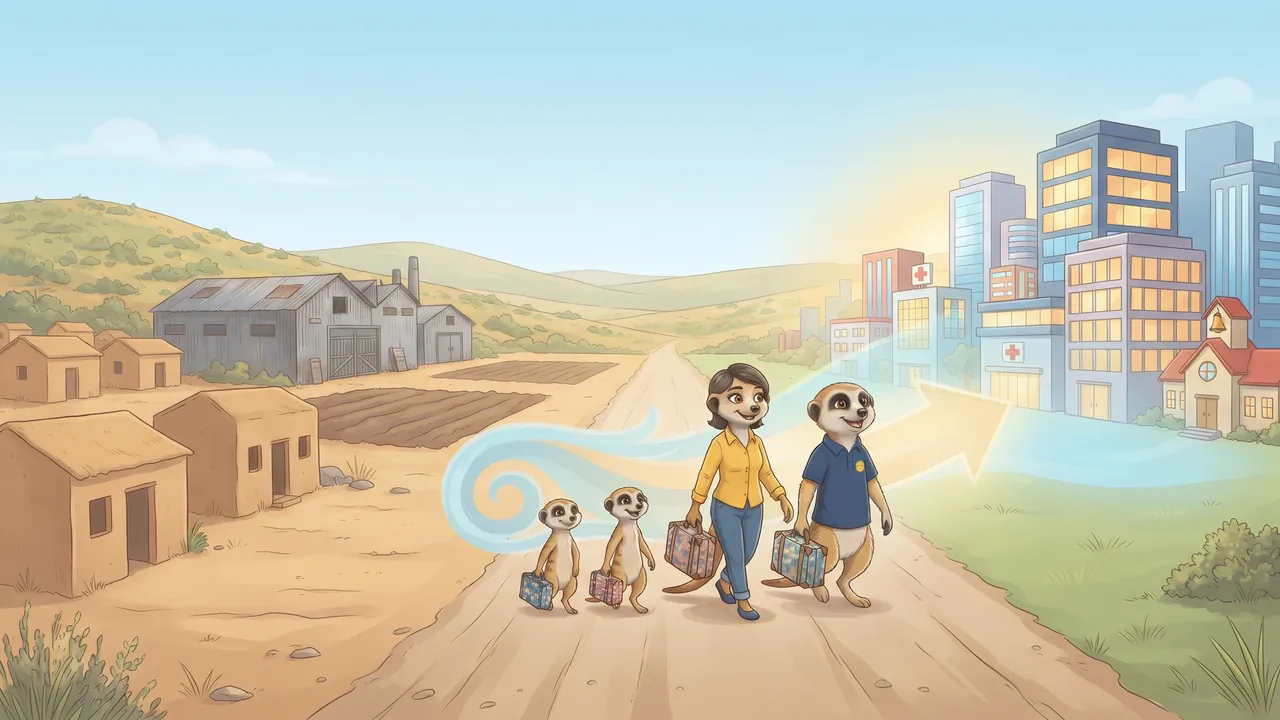
Urbanisation is when people move from the countryside to cities. They are looking for work and services. When a city grows too fast, there is pressure on housing, and informal settlements grow without planning. A rural town that young people leave slowly shrinks.
- A suburb is a living area outside the city centre.
- A satellite town is a smaller town beside a big city.
- A metropolis is a very large city with millions of people; a capital city is where the government is based. South Africa has three: Pretoria (government), Cape Town (Parliament) and Bloemfontein (Supreme Court of Appeal).
- Emigration is when people move to another country.
- Push factors drive people away from rural areas: few jobs, drought and poor harvests, and few schools, clinics and services.
- Pull factors attract people to cities: jobs, better schools and hospitals, electricity and water, and entertainment.
What decides where people live?
- Climate and vegetation: people prefer places with enough rain and good soil.
- Natural features: rivers, harbours and flat land make building and transport easier.
- Resources and work: mining towns (Kimberley, Rustenburg), fishing towns (Lambert’s Bay, Gansbaai) and trading towns at harbours.
- Laws: in the past, apartheid laws decided where people of different races were allowed to live. Today everyone may choose where they live.
| Province | People (Census 2022) and density |
|---|---|
| Gauteng | About 15.1 million; about 830 people per km². The most people and the most densely populated, even though it is the smallest province |
| KwaZulu-Natal | About 12.4 million; about 130 people per km². The second most people |
| Western Cape | About 7.4 million; about 57 people per km² |
| Eastern Cape | About 7.2 million; about 43 people per km² |
| Limpopo | About 6.6 million; about 52 people per km² |
| Mpumalanga | About 5.1 million; about 67 people per km² |
| North West | About 3.8 million; about 36 people per km² |
| Free State | About 3.0 million; about 23 people per km² |
| Northern Cape | About 1.4 million; fewer than 4 people per km². The fewest people and the most sparsely populated, even though it is the largest province |
| South Africa | About 62 million; about 51 people per km² |

On a bar graph of the provinces, the tallest bar has the most people. But the most people does not always mean the most densely populated: Mpumalanga has fewer people than the Western Cape but is more densely populated, because it is smaller.
Remember this and test yourself
- Early settlements formed near water; towns also grow at crossroads, railways, river crossings and mines.
- Densely populated: many people in a small area (Gauteng). Sparsely populated: few people over a large area (Northern Cape).
- Rural: farming, fishing and forestry. Urban: factories, shops and offices.
- Urbanisation is people moving to cities, looking for work and services; it puts pressure on housing.
- A metropolis has millions of people; a satellite town lies beside a big city; an informal settlement grew without planning.
Write these points in your book. Read them again the night before the test.

Dense = dozens close together. Sparse = spread far apart.
Important words
First say what the word means, then turn the card over.
Match column A to column B
Tap a word in column A, then its meaning in column B. You can also start in column B.
True or false?
Read the question and the answer. Is the answer right? Tap True or False.

Now the real quiz!
The quiz has many more questions on this topic. Every question shows straight away whether you are right and explains why.
Take the quiz: Why people live where they do- Read one part together and ask your child to tell it back in their own words.
- The ticks (“I know this”) are saved on this device only. We never ask for names or emails.
Follows CAPS for Grade 6 Social Sciences (Geography). Always check your teacher’s notes and textbook too.