
Vegetation regions of South Africa
South Africa’s vegetation regions, the layers of the rainforest, and how people threaten vegetation. Read one part at a time and tap “I know this”. Then test yourself in the quiz.
Know it already? Jump straight to the quiz
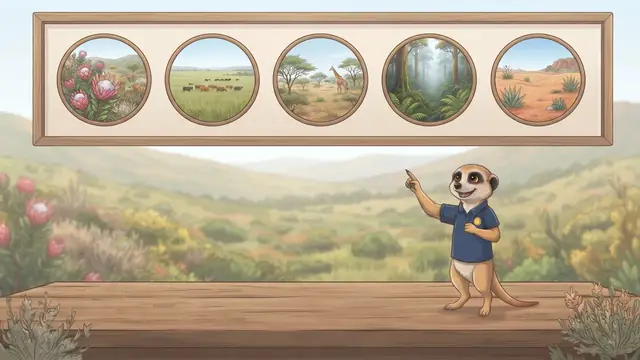
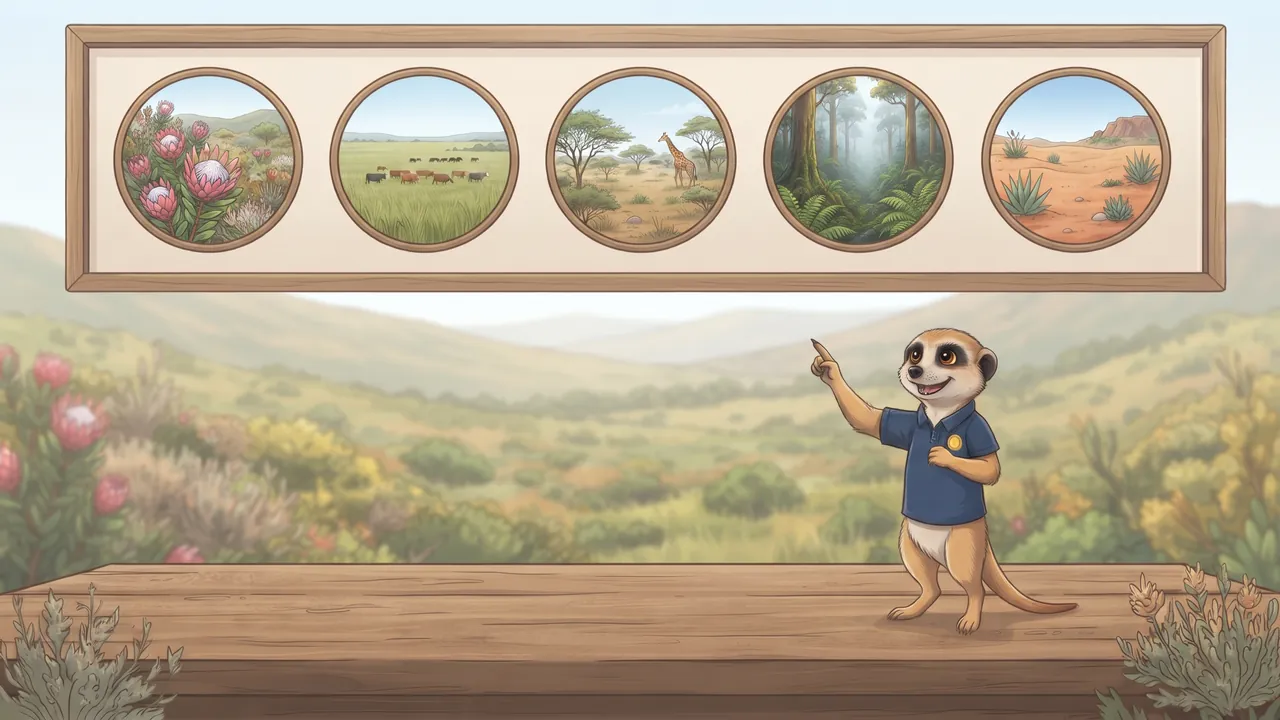
South Africa’s vegetation regions
A vegetation region is an area with its own natural plants. The climate and the soil decide which plants grow there. On a vegetation map each colour shows a different region.
| Region | Where | Features |
|---|---|---|
| Savanna (bushveld) | Limpopo, the north and east; the largest region | Grassland with scattered trees |
| Grassland | The Highveld | Mainly grass; grazing for livestock and game |
| Fynbos | The south-western Cape, to the southern tip | Proteas; winter rain |
| Montane forest | High on mountains | Cooler, because it is higher above sea level |
| Coastal forest | The east, along the coast | Warm and wet |
| Semi-desert (Karoo) | The central and western interior (Great Karoo, Namaqualand) | Low shrubs and succulents (vygies, karoo bushes); little rain, hot summers and cold winters; Namaqualand is famous for its spring flowers |
| Desert | The far north-west | Very little rain |
The layers of a tropical rainforest
Most rainforests are near the equator. They grow in layers:
- Emergents: the very tallest trees sticking out above.
- The canopy: the tops of most trees; it blocks out most sunlight.
- The understorey: smaller trees and shrubs below the canopy.
- The forest floor: dark, with rotting leaves.
Threats to vegetation
- Deforestation: cutting down forests on a large scale. Animals lose their homes and the soil washes away.
- Overgrazing: too much livestock leaves the soil bare.
- Invasive plants: alien plants that crowd out indigenous ones.

Indigenous plants suited to your region use the least water in the garden.
Case study: the Amazon
The Amazon rainforest in South America is the largest tropical rainforest on Earth. Every year a large part of it is cut down.
| Reasons for deforestation | Consequences |
|---|---|
| Trees are cut for timber | Animals and plants lose their homes; some die out |
| Land is cleared for cattle ranches and soya beans | The soil washes away once the trees are gone |
| Roads and mines are built | Less rain, and more carbon dioxide stays in the air |
| More people move into the forest | Indigenous people lose their land |
Solutions: protected parks, planting new trees, and buying timber and food grown sustainably.
Remember this and test yourself
- A vegetation region has its own natural plants, decided by the climate and soil.
- Savanna (bushveld) covers the largest part of South Africa, as in Limpopo.
- Fynbos in the south-western Cape; grassland on the Highveld; montane forests high and cool; semi-desert (Karoo) in the interior; desert in the far north-west.
- A rainforest has four layers: emergents, the canopy, the understorey and the forest floor.
- Deforestation, overgrazing and invasive plants threaten vegetation.
Write these points in your book. Read them again the night before the test.

The rainforest from top to bottom: Emergents, Canopy, Understorey, Floor: “Every Cat Understands Food.”
Important words
First say what the word means, then turn the card over.
Match column A to column B
Tap a word in column A, then its meaning in column B. You can also start in column B.
True or false?
Read the question and the answer. Is the answer right? Tap True or False.

Now the real quiz!
The quiz has many more questions on this topic. Every question shows straight away whether you are right and explains why.
Take the quiz: Vegetation regions of South Africa- Read one part together and ask your child to tell it back in their own words.
- The ticks (“I know this”) are saved on this device only. We never ask for names or emails.
Follows CAPS for Grade 6 Social Sciences (Geography). Always check your teacher’s notes and textbook too.