
Climate and vegetation across the world
The world’s climate regions, from the tropical rainforest to the polar ice, and what decides a place’s climate. Read one part at a time and tap “I know this”. Then test yourself in the quiz.
Know it already? Jump straight to the quiz
Weather or climate?
| Weather | Climate |
|---|---|
| What the air is like today or this week | The average weather of a place over many years (30 years or more) |
| “It is raining in George today.” | “Cape Town gets most of its rain in winter.” |
- On a January temperature map the south is warm (our summer) and the north cold; on a July map it is the other way round.
- The world has hot regions (near the equator), temperate regions (in between) and cold regions (near the poles).
- An annual rainfall map shows the wettest areas near the equator and the driest in the deserts near the tropics.
What decides climate?
- Distance from the equator: at the equator the sun’s rays fall directly, at the poles at a slant.
- Height above sea level: the higher, the cooler.
- The sea: a coastal town has milder temperatures; a warm ocean current (the Agulhas Current on our east coast) makes the coast warmer and wetter; a cold current (the Benguela Current on the west coast) makes the coast cooler and drier, which helps form the Namib Desert.
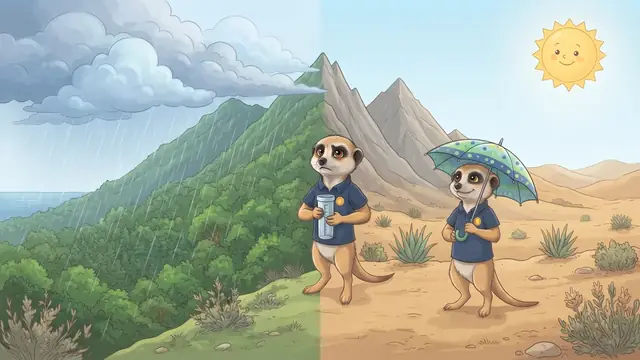
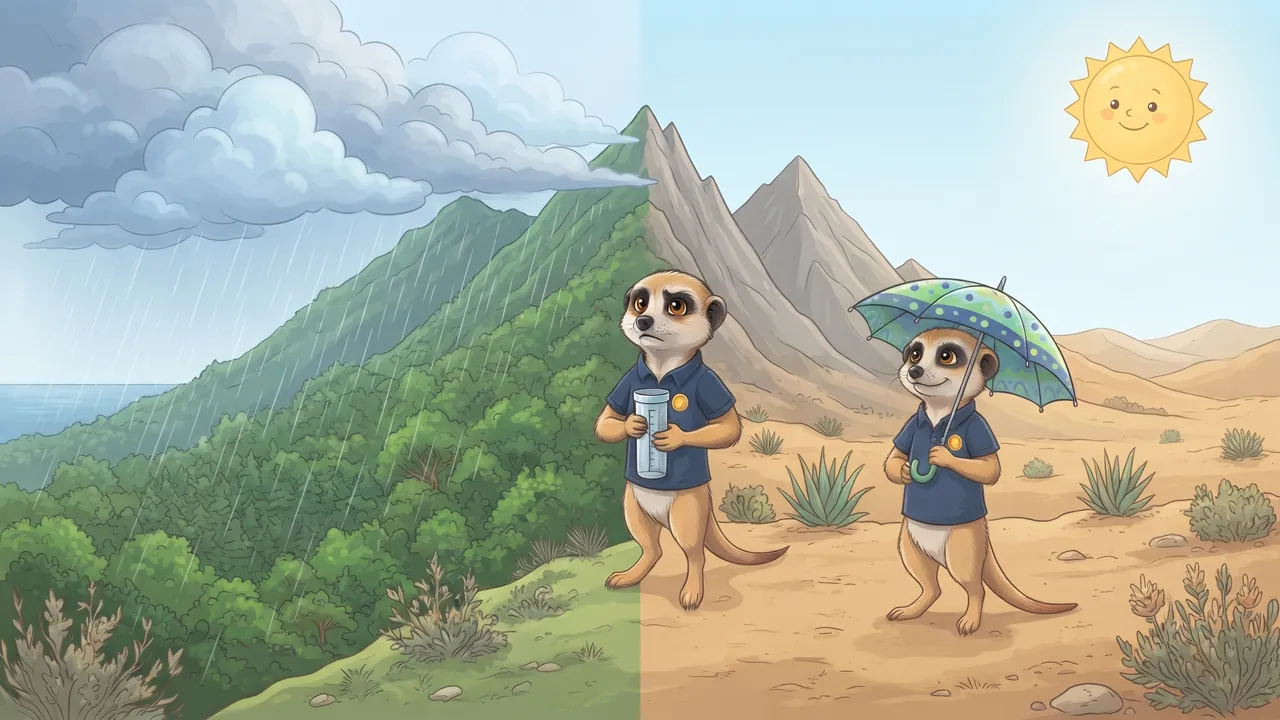
- Mountains: the side facing the wind gets the most rain. The dry side behind the mountain is the rain shadow.
The world’s climate regions
| Region | Climate | Vegetation |
|---|---|---|
| Tropical (near the equator) | Hot and very wet | Dense rainforest |
| Savanna | Hot, summer rain | Grassland with a few trees |
| Desert | Hot days, cold nights, little rain | Plants that store water |
| Mediterranean | Hot dry summers, wet winters | Fynbos and other hard-leaved shrubs (farmers grow grapes and olives here) |
| Temperate | Four distinct seasons | Forests and grasslands |
| Cold (conifer forest) | Long, cold winters | Conifers |
| Polar and tundra | Very cold | Moss and short grass; no trees |
South Africa’s climate
Most of South Africa has a semi-arid climate. The south-western Cape, around Cape Town, has a Mediterranean climate: dry summers and wet winters, perfect for grapes and olives. The Namib is a desert along Namibia’s coast.

A microclimate is the climate of a very small area, such as the shady side of your school.
Plants and animals adapt
- A desert plant stores water in thick parts.
- Conifers grow in cold regions: their needles lose little water in frost.
- The polar bear is well adapted to the cold polar region.
- The Amazon forest takes in a lot of carbon dioxide and matters for the whole world.
Three natural regions up close
| Tropical rainforest | |
|---|---|
| Where | Near the equator (about 10° N to 10° S): the Amazon, the Congo, South-East Asia |
| Temperature | Hot all year (about 25–28 °C); no winter |
| Rain | Almost every day; more than 2 000 mm a year |
| Plants | Giant trees, climbing vines, orchids |
| Animals | Jaguars, toucans, sloths, gorillas in the Congo, frogs and insects |
| People | Indigenous communities hunt, gather and farm small plots; logging |
| Hot desert | |
|---|---|
| Where | Near the tropics (about 15°–30° N and S), often on the west side of a continent: Sahara, Arabian Desert, Namib, Atacama |
| Temperature | Very hot days (sometimes above 40 °C), cold nights |
| Rain | Very little; less than 250 mm a year |
| Plants | Succulents (and cacti in American deserts) store water in thick stems or leaves; many have shallow, wide roots to catch rain quickly, while plants such as acacias send very long roots down to groundwater; date palms at an oasis; welwitschia in the Namib |
| Animals | Camels, desert foxes, gemsbok, scorpions |
| People | Nomads like the Tuareg and Bedouin move with camels and goats; others live at an oasis |
| Coniferous forest | |
|---|---|
| Where | Far north (about 50°–70° N): Canada, Russia, Scandinavia. Only in the Northern Hemisphere, because the south has no large land areas at those latitudes |
| Temperature | Long, very cold winters (often below –20 °C), short cool summers |
| Rain | Moderate; much of it falls as snow |
| Plants | Pines and other conifers; moss |
| Animals | Bears, wolves, reindeer and owls |
| People | Loggers, paper mills, mines and hunting |
How do people live in a hot desert? They wear loose, long clothes and head cloths against the sun and sand, travel in the cool mornings and evenings, and live near an oasis, where groundwater comes to the surface. Nomads move from pasture to pasture with their animals. In the Kalahari the San learnt to get water from roots and tsamma melons.
Remember this and test yourself
- Climate is a region’s long-term weather pattern.
- Near the equator the sun’s rays fall directly: hot. At the poles they fall at a slant: cold.
- Altitude (higher is cooler), the sea (moderates temperatures) and ocean currents also affect climate.
- Regions: tropical (rainforest), desert, temperate (four seasons), Mediterranean (south-western Cape), polar/tundra.
- The side of a mountain facing the wind gets the most rain; behind the mountain is the rain shadow.
Write these points in your book. Read them again the night before the test.

Moving away from the equator: tropical rainforest → hot desert (near the tropics) → temperate → cold coniferous forest → polar. In general it gets colder, like stairs to the freezer, but hot deserts have the hottest days of all.
Important words
First say what the word means, then turn the card over.
Match column A to column B
Tap a word in column A, then its meaning in column B. You can also start in column B.
True or false?
Read the question and the answer. Is the answer right? Tap True or False.

Now the real quiz!
The quiz has many more questions on this topic. Every question shows straight away whether you are right and explains why.
Take the quiz: Climate and vegetation across the world- Read one part together and ask your child to tell it back in their own words.
- The ticks (“I know this”) are saved on this device only. We never ask for names or emails.
Follows CAPS for Grade 6 Social Sciences (Geography). Always check your teacher’s notes and textbook too.