
Skeletons, joints and moving systems
Joints and muscles in the body, and wheels, axles and the bicycle as a system. Read one part at a time and tap “I know this”. Then test yourself in the quiz.
Know it already? Jump straight to the quiz

Joints and muscles
| Joint | Moves like this | Example |
|---|---|---|
| Hinge | One direction, like a door | Elbow, knee |
| Ball-and-socket | Round, in many directions | Shoulder, hip |
| Fixed joint | Does not move | Skull |
A muscle can only pull, not push. That is why muscles work in pairs: one bends the joint, the other straightens it. Cartilage at the ends of bones is a cushion. The backbone is made of many small bones (vertebrae) so it can bend and still protect.
Wheels and axles
- A heavy box on a trolley moves more easily: wheels reduce friction.
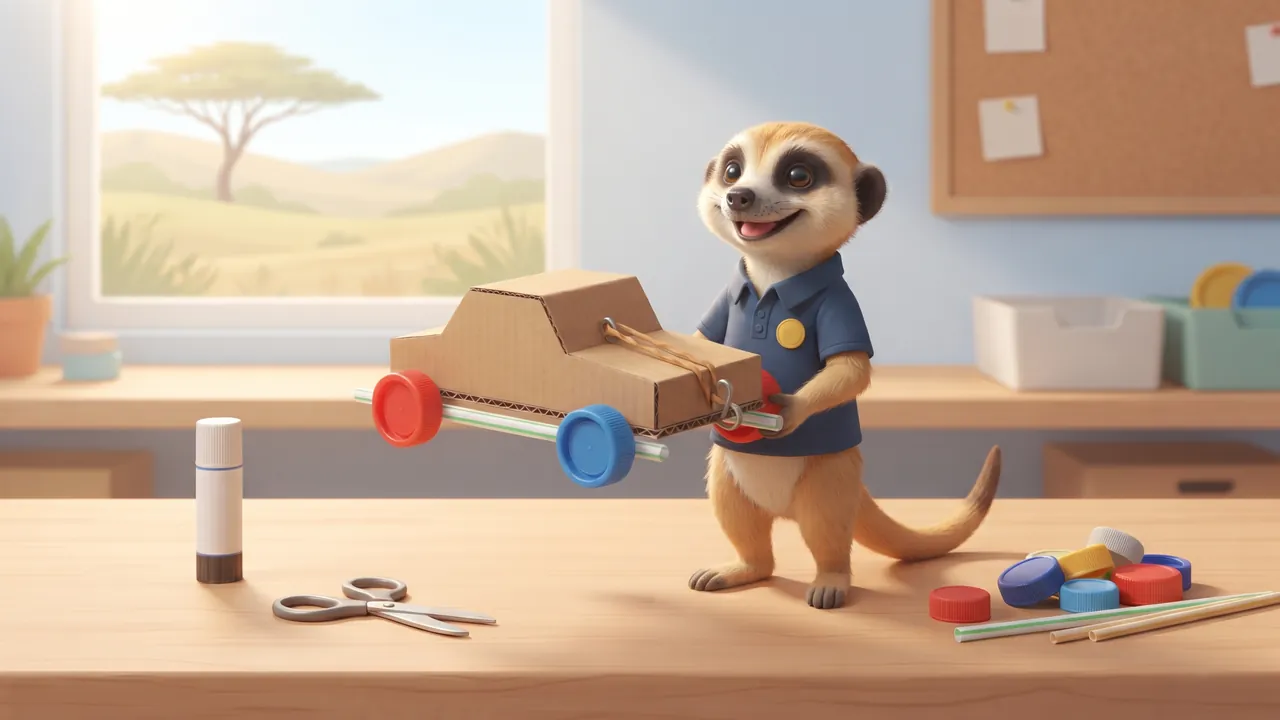
- Fixed axle: the axle is fixed to the chassis and the wheel turns on it.
- Rotating axle: the wheels are fixed to the axle and turn with it.
- The model rolls crooked? Check that the axles are straight and parallel. Wheels rub? Put a washer between wheel and chassis.
The bicycle: a system
| Part | Job |
|---|---|
| Pedals | You push them to get the bicycle going |
| Chain | Carries the pedals’ movement to the back wheel |
| Handlebars | To steer |
| Spokes | Thin rods between the hub and the rim |
| Brakes | Rubber pads press on the rim: friction |

A ladder against a wall has no wheels and axles; a wheelbarrow does.
Remember this and test yourself
- A joint is where two bones meet.
- The elbow is a hinge joint; the shoulder and hip are ball-and-socket joints; the skull’s joints do not move.
- Muscles contract and pull on the bones; they work in pairs. Tendons attach muscles to bones.
- An axle is the rod a wheel turns on; wheels reduce friction.
- A mechanism passes on movement; a system is a group of mechanisms with one purpose, like a bicycle.
Write these points in your book. Read them again the night before the test.

Elbow = door (hinge, one way). Shoulder = joystick (ball, all ways). Muscles can only pull, never push.
Important words
First say what the word means, then turn the card over.
Match column A to column B
Tap a word in column A, then its meaning in column B. You can also start in column B.
True or false?
Read the question and the answer. Is the answer right? Tap True or False.

Now the real quiz!
The quiz has many more questions on this topic. Every question shows straight away whether you are right and explains why.
Take the quiz: Skeletons, joints and moving systems- Read one part together and ask your child to tell it back in their own words.
- The ticks (“I know this”) are saved on this device only. We never ask for names or emails.
Follows CAPS for Grade 5 Natural Sciences and Technology. Always check your teacher’s notes and textbook too.