
Food chains and food webs
How food chains form a food web, and what happens when the balance is upset. Read one part at a time and tap “I know this”. Then test yourself in the quiz.
Know it already? Jump straight to the quiz
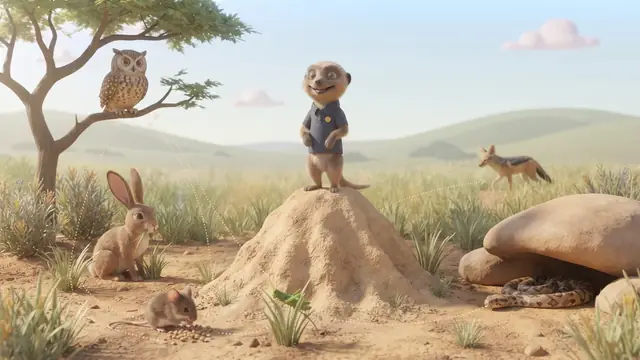
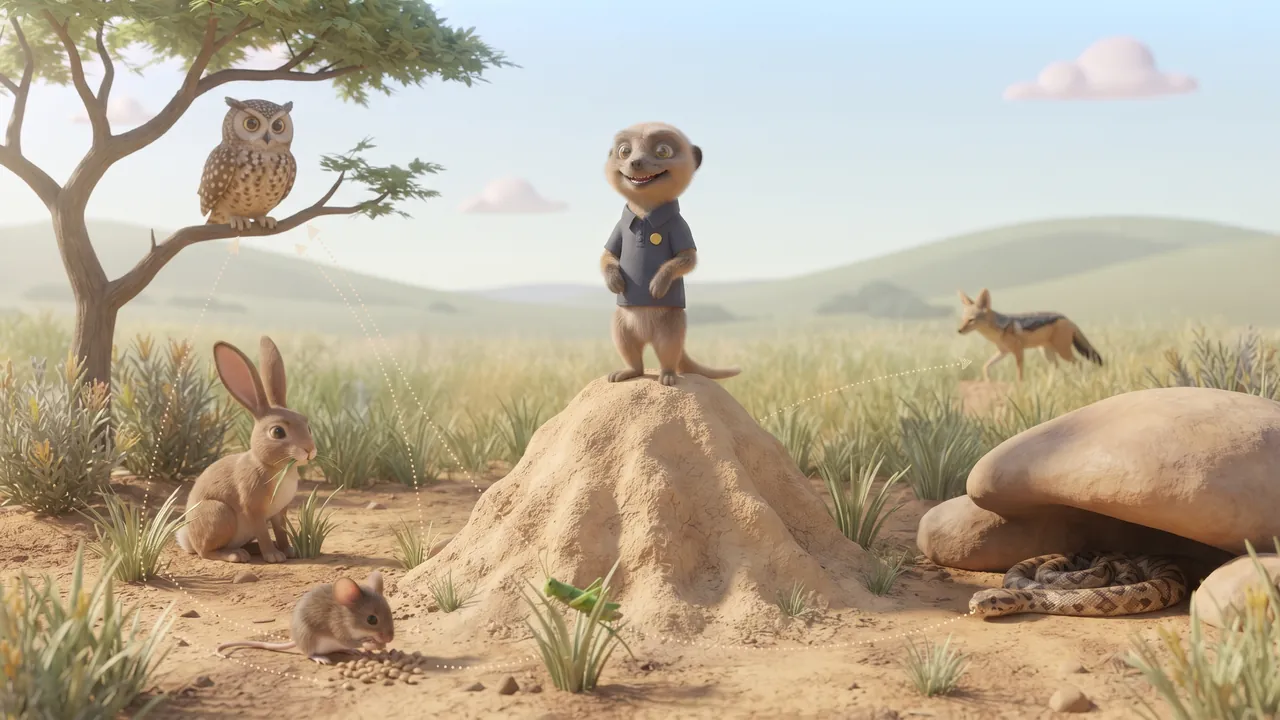
From chain to web
- Producers (green plants) make their own food using energy from sunlight.
- Consumers are animals that eat other living things to get energy.
- A herbivore eats only plants, like a zebra or a grasshopper. A carnivore eats only other animals, like a lion or a snake. An omnivore eats plants and animals, like a baboon or a person.
- A food chain always starts with a producer. Each arrow points from the food to the animal that eats it: grass → grasshopper → frog → snake.
In real nature an animal eats more than one thing, and more than one animal eats it. If you draw all the chains together, you get a food web. The level an organism occupies in the web is its trophic level.
When the balance is upset
- If all the plants die, the plant eaters suffer first.
- If a predator disappears, its prey increase and the whole web is upset.
- Too much hunting or a new species brought in can upset the balance.
- Poison builds up and gets worse higher up the web.

The more kinds (biodiversity), the stronger the web.
Scavengers and decomposers
A scavenger, like a vulture, eats animals that are already dead. Decomposers such as bacteria in the soil break down the rest and return nutrients. An ecosystem’s carrying capacity is how many animals it can support.
Remember this and test yourself
- A food web is many food chains linked together.
- The arrow points from the food to the animal that eats it: it shows the direction the energy moves. All the energy first comes from the Sun, but a food chain always starts with a producer (a green plant).
- Plants (and algae in water) are producers; a top predator is at the top of the web.
- Only about one tenth of the energy passes to the next level: so there are fewer predators than prey.
- Decomposers (bacteria, fungi) break down dead material; without them it piles up and the soil gets poor.
Write these points in your book. Read them again the night before the test.

The arrow shows where the food energy goes, not who hunts. Every step up: only about one tenth goes along.
Important words
First say what the word means, then turn the card over.
Match column A to column B
Tap a word in column A, then its meaning in column B. You can also start in column B.
True or false?
Read the question and the answer. Is the answer right? Tap True or False.

Now the real quiz!
The quiz has many more questions on this topic. Every question shows straight away whether you are right and explains why.
Take the quiz: Food chains and food webs- Read one part together and ask your child to tell it back in their own words.
- The ticks (“I know this”) are saved on this device only. We never ask for names or emails.
Follows CAPS for Grade 5 Natural Sciences and Technology. Always check your teacher’s notes and textbook too.