
Body fossils, trace fossils and South African fossils
Body and trace fossils, how fossils form, and South Africa’s famous fossils. Read one part at a time and tap “I know this”. Then test yourself in the quiz.
Know it already? Jump straight to the quiz
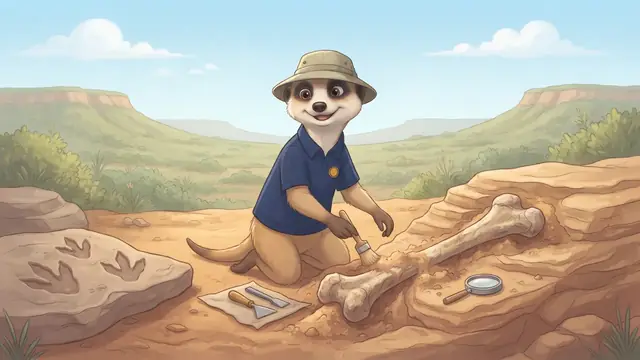
Two kinds of fossils
| Body fossil | Trace fossil |
|---|---|
| Real remains | A sign the animal was there |
| A shark tooth in limestone | A dinosaur footprint |
| A skull, a shell, petrified wood | A burrow an animal dug |
A chicken bone from last night is not a fossil: fossils are very, very old. In rock layers a fossil in a lower layer is usually older.
What fossils tell us
- Teeth show what food the animal ate.
- A trail of footprints shows how big the animal was and how fast it moved.
- At Golden Gate some of the oldest dinosaur eggs with tiny embryos were found: those dinosaurs nested and laid eggs there.
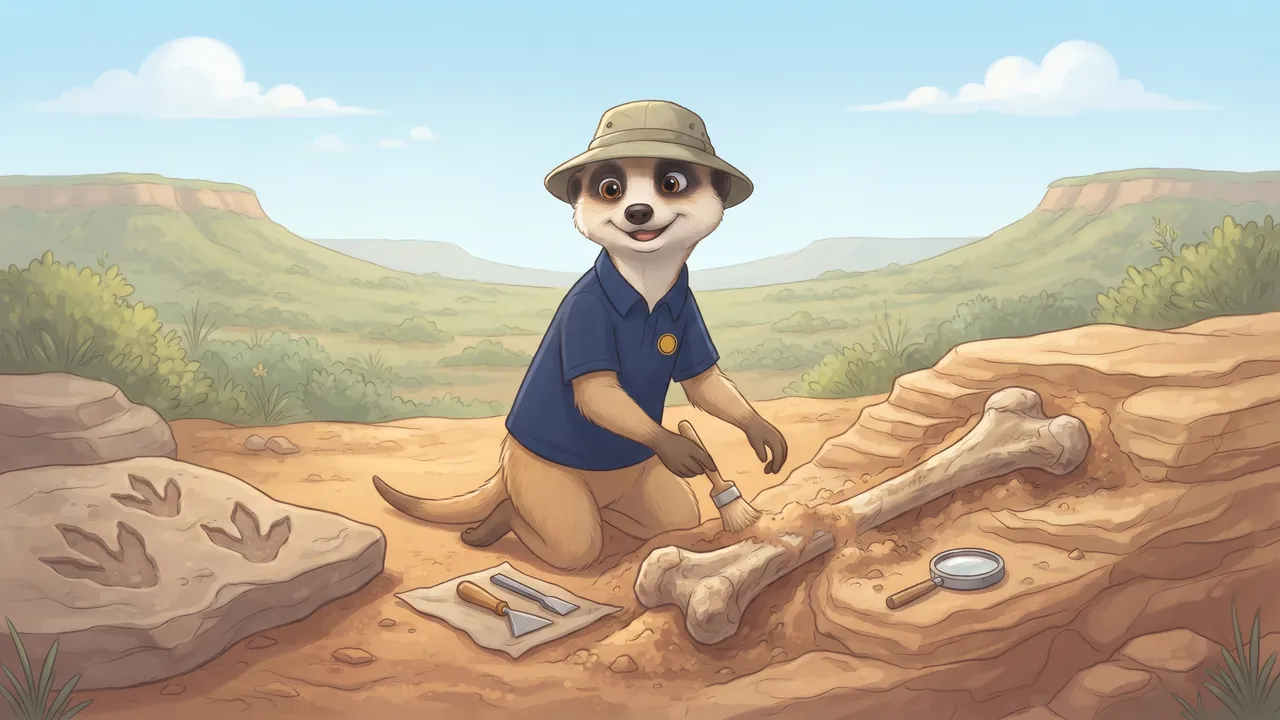
South Africa’s fossil treasures
| Fossil | Where |
|---|---|
| Mrs Ples (skull) | Sterkfontein Caves, Cradle of Humankind, Gauteng |
| Homo naledi (2013) | A cave in the Cradle of Humankind |
| Taung Child | North West |
| Massospondylus (plant-eating dinosaur) | Golden Gate Highlands National Park |
| Ancient reptiles and dinosaurs | The rocks of the Karoo |
| Coelacanth (a ‘living fossil’) | Caught near East London in 1938 |
South Africa’s fossils are important because they help scientists understand how life on Earth, and early humans, developed over millions of years. The Cradle of Humankind is a World Heritage Site. Raymond Dart described the Taung Child’s skull (found in 1924); Robert Broom and John Robinson found Mrs Ples at Sterkfontein in 1947.

The coelacanth is called a living fossil, because it has hardly changed in millions of years.
How a fossil forms
- A plant or animal is quickly covered by mud or sand, usually under water.
- The soft parts rot away; the hard parts (bones, teeth, shells, wood) stay behind.
- Over millions of years more layers settle on top and press the lower layers into sedimentary rock.
- Minerals in the water slowly replace the hard parts, so they turn to stone.
- Much later, erosion wears the rock away and the fossil is exposed.
Remember this and test yourself
- A body fossil is real remains (bones, teeth, shells); a trace fossil is a sign it was there (a footprint).
- A palaeontologist studies fossils with small brushes and chisels.
- Hard parts fossilise most easily; soft parts rot quickly. Buried quickly = better chance.
- The Cradle of Humankind (Gauteng): Mrs Ples, Homo naledi. The Taung Child: North West.
- Fossils are protected by law: never take them home.
Write these points in your book. Read them again the night before the test.
Body fossil = the animal’s body itself. Trace fossil = the animal’s trace (footprints, burrows).
Important words
First say what the word means, then turn the card over.
Match column A to column B
Tap a word in column A, then its meaning in column B. You can also start in column B.
True or false?
Read the question and the answer. Is the answer right? Tap True or False.

Now the real quiz!
The quiz has many more questions on this topic. Every question shows straight away whether you are right and explains why.
Take the quiz: Body fossils, trace fossils and South African fossils- Read one part together and ask your child to tell it back in their own words.
- The ticks (“I know this”) are saved on this device only. We never ask for names or emails.
Follows CAPS for Grade 5 Natural Sciences and Technology. Always check your teacher’s notes and textbook too.