
Animals, skeletons and adaptations
Skeletons inside and outside, what a skeleton does, and how animals are adapted to their habitat. Read one part at a time and tap “I know this”. Then test yourself in the quiz.
Know it already? Jump straight to the quiz
Inside or outside?
| Endoskeleton (inside) | Exoskeleton (outside) | |
|---|---|---|
| Who has it? | Vertebrates: human, cat, fish | Beetles, spiders, crabs |
| Growth | Grows with the animal | Must be shed, because it cannot stretch |
A shark’s skeleton is made of cartilage, not bone. A tortoise’s hard shell protects it from predators.
Adaptations
| Animal | Adaptation |
|---|---|
| Bird | Hollow bones: light enough to fly |
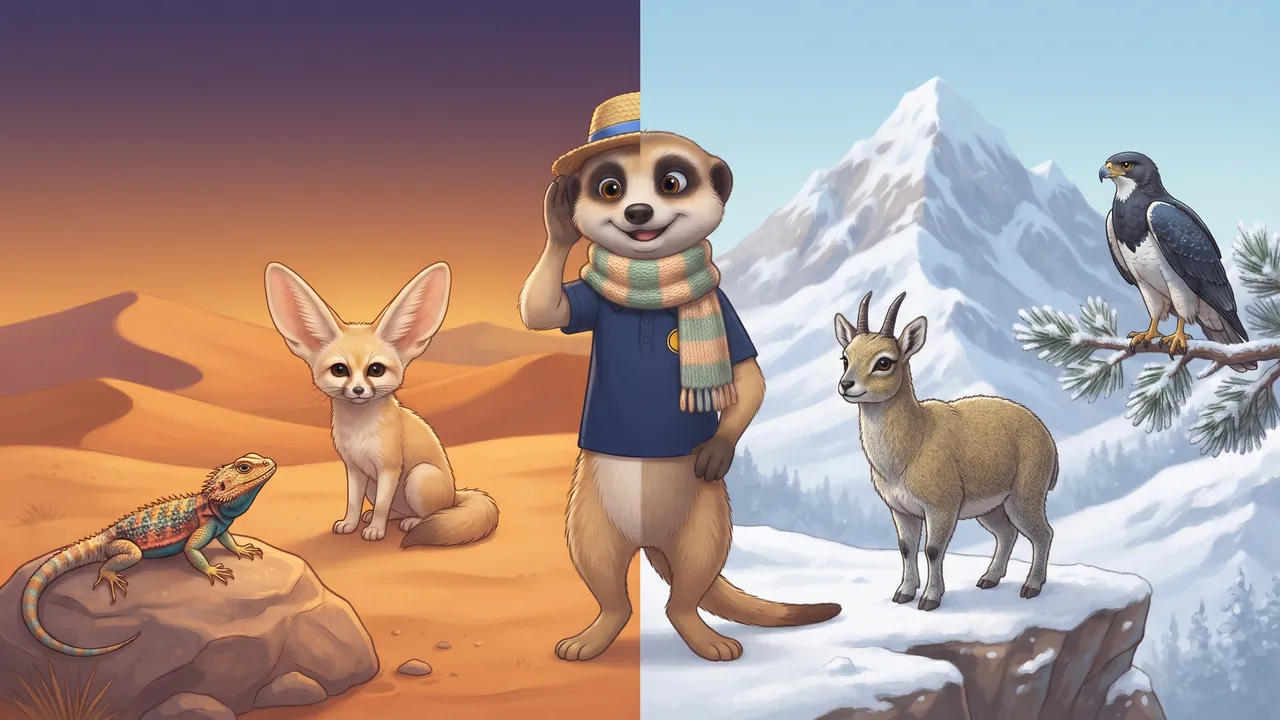
| Fennec fox | Big ears to lose body heat |
| Giraffe | Long neck to reach high leaves |
| Bird of prey | Sharp claws and a hooked beak |
| Bat | Echolocation to hunt in the dark |
| Mole | Tiny eyes: lives in the dark |
| Fish | Swim bladder to stay floating at a depth |
Warm- and cold-blooded
Mammals and birds are warm-blooded: their bodies keep themselves warm. A lizard is cold-blooded: it basks in the morning sun to warm up. In a very cold habitat a thick layer of fat or fur helps.
Animals with and without bones
| Group | Examples |
|---|---|
| Invertebrates (no backbone) | Worms, millipedes, insects, spiders, scorpions, crabs; some have a hard shell |
| Vertebrates (with a backbone) | Fish, amphibians (frogs and toads), reptiles, birds and mammals, including people |
| Part of the skeleton | Job |
|---|---|
| Skull | Protects the brain |
| Backbone (vertebrae) | Protects the spinal cord |
| Ribs | Protect the heart and lungs |
| Shoulder blades, arms, legs, hip bones | For movement |
Not all animals have limbs: a fish and a snake have no arms or legs. A crab’s hard shell is a shell structure; a vertebrate skeleton is a frame structure.
Remember this and test yourself
- A skeleton supports and protects the body and helps with movement.
- The skull protects the brain; the rib cage protects the heart and lungs.
- Vertebrates have a skeleton inside; insects and spiders have an exoskeleton on the outside.
- Muscles pull on bones to make movement. Bones contain a lot of calcium, which makes them hard and strong.
- An adaptation helps an animal survive: hollow bones for flying, big ears to lose heat.
Write these points in your book. Read them again the night before the test.

Endo = inside (our bones), exo = outside (the beetle’s armour). The skull is the brain’s helmet, the ribs the heart’s cage.
Important words
First say what the word means, then turn the card over.
Match column A to column B
Tap a word in column A, then its meaning in column B. You can also start in column B.
True or false?
Read the question and the answer. Is the answer right? Tap True or False.

Now the real quiz!
The quiz has many more questions on this topic. Every question shows straight away whether you are right and explains why.
Take the quiz: Animals, skeletons and adaptations- Read one part together and ask your child to tell it back in their own words.
- The ticks (“I know this”) are saved on this device only. We never ask for names or emails.
Follows CAPS for Grade 5 Natural Sciences and Technology. Always check your teacher’s notes and textbook too.