
The first farmers
The first farmers: crops, livestock, iron, villages, surplus and trade. Read one part at a time and tap “I know this”. Then test yourself in the quiz.
Know it already? Jump straight to the quiz
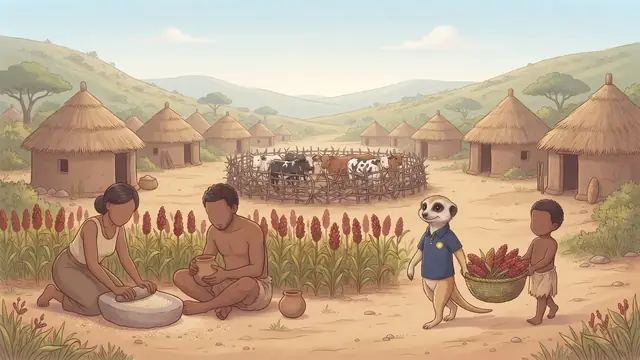
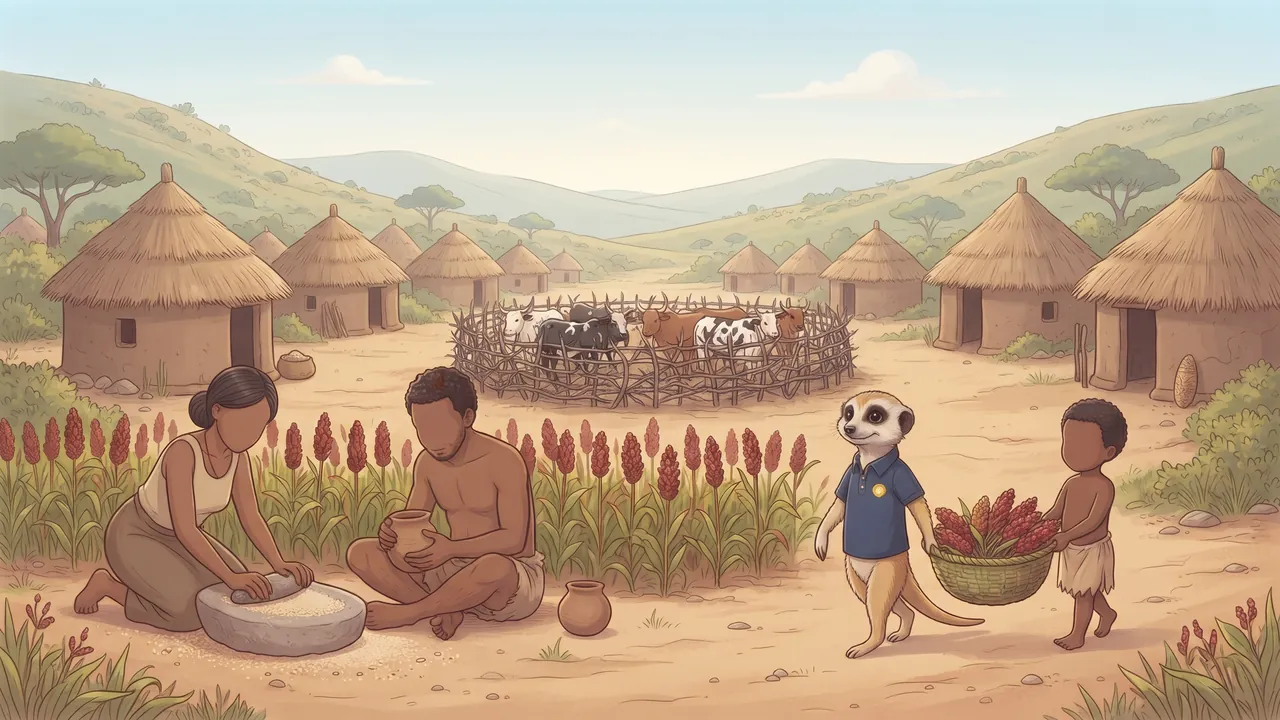
The farming village
- Villages near rivers for water and grazing; a permanent village is a settlement.
- Huts of poles, mud and grass. Grain was ground into flour with two grindstones; clay pots held water.
- Cattle were a sign of wealth: food, hides and status. Iron was smelted in a furnace.
- Drawback: firewood nearby got used up.
How we know
Archaeologists dig up villages and find pottery and iron tools. Trade began when groups exchanged what they had.
When they came, and how they worked together
- The first farmers, who spoke Bantu languages, arrived in southern Africa about 2 000 to 1 700 years ago.
- Where and why: they settled mostly in the wetter eastern half of the country (today’s Limpopo, Mpumalanga, KwaZulu-Natal and Eastern Cape), because summer rain, fertile soil, grazing, water and wood made farming possible. The dry west was left to hunter-gatherers and herders.
- Attitude to land: land belonged to the whole community and could not be bought or sold (communal ownership of land). The chief gave each family land to live on and farm.
- They lived alongside the Khoisan. The click sounds in Nguni languages such as isiXhosa and isiZulu come from the Khoisan languages.
- Good leaders accepted strangers and took them into the community.
- A culture of co-operation: neighbours worked together in work parties to dig and hoe each other’s fields with iron hoes in the ploughing (planting) season, and a new family could borrow a calf or two to start a herd.
- A chief and his people formed a chiefdom (do not call it a ‘tribe’): a group of homesteads under one chief. Chiefdoms were flexible: if people were unhappy they could move to another chief, so chiefdoms grew, split up and changed over time.
Remember this and test yourself
- The biggest change: people could stay in one place.
- Livestock: cattle, sheep and goats; crops: sorghum and millet (maize came much later from the Americas).
- They learnt to use iron: an iron hoe is stronger and lasts longer than stone. This was the Iron Age.
- A surplus is extra food; it was stored and traded (iron and salt).
- Specialisation: people do different kinds of work, like potters and smiths.
Write these points in your book. Read them again the night before the test.

Farmers have a pantry: stored surplus, so they could stay. Hunters have a path.
Important words
First say what the word means, then turn the card over.
Match column A to column B
Tap a word in column A, then its meaning in column B. You can also start in column B.
True or false?
Read the question and the answer. Is the answer right? Tap True or False.

Now the real quiz!
The quiz has many more questions on this topic. Every question shows straight away whether you are right and explains why.
Take the quiz: The first farmers- Read one part together and ask your child to tell it back in their own words.
- The ticks (“I know this”) are saved on this device only. We never ask for names or emails.
Follows CAPS for Grade 5 Social Sciences (History). Always check your teacher’s notes and textbook too.