
Heritage and heritage routes
Heritage, heritage sites and routes, and Frances Baard from Kimberley. Read one part at a time and tap “I know this”. Then test yourself in the quiz.
Know it already? Jump straight to the quiz
Preserving heritage
| Word | Meaning |
|---|---|
| Monument | Built to remember people or events |
| Museum | Keeps and displays objects behind glass to protect them |
| Archive | Where old documents are kept |
| Heritage council | Protects historic places |
| Fossil site | Where early human remains were found |
- Oral histories are recorded so the voice and words are kept exactly. You can record older people’s stories.
- Old buildings are restored rather than demolished. A sacred place, such as a church or mosque, is treated with respect. Grandma’s recipes are part of your family’s heritage.
- Heritage Day is on 24 September.
Kimberley and Frances Baard
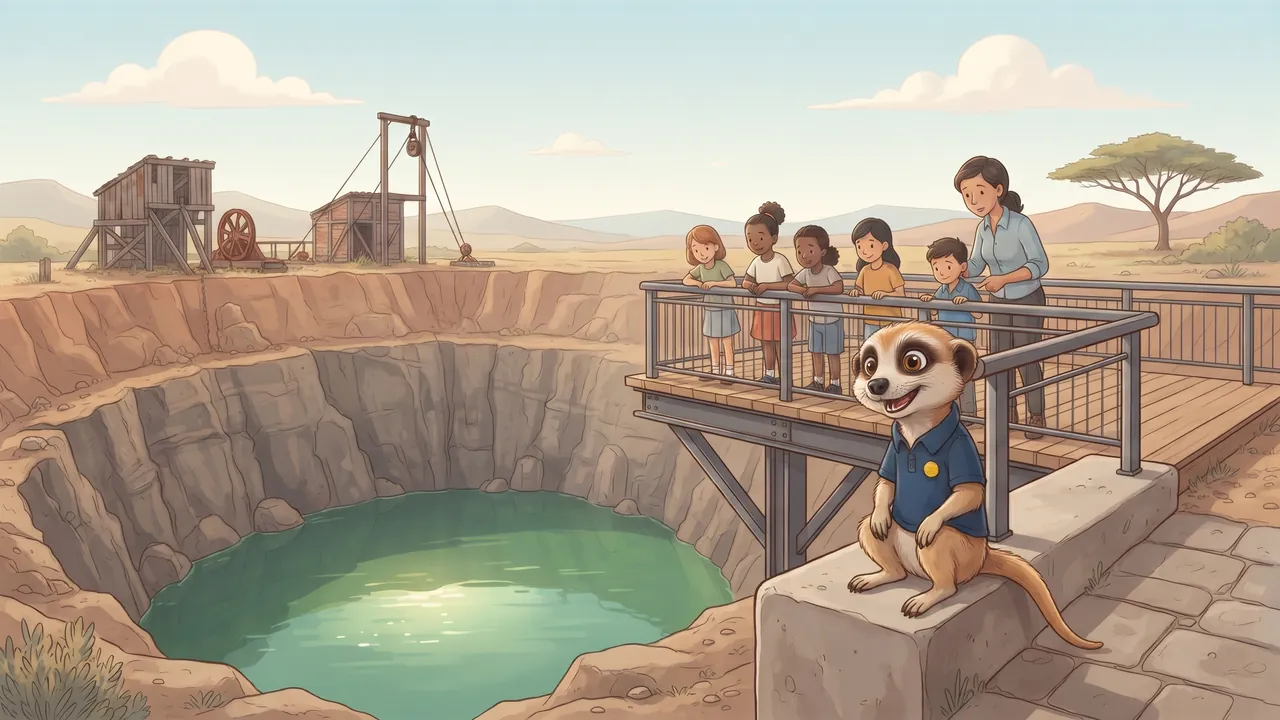
The Big Hole in Kimberley (Northern Cape) was dug for diamonds. Frances Baard was first a teacher and domestic worker, then a trade union leader (a trade union is workers standing together for fair pay). The district around Kimberley and Schoeman Street in Pretoria (2012) were named after her. National Women’s Day (9 August) remembers 9 August 1956, when about 20 000 women marched to the Union Buildings in Pretoria to protest against the pass laws (laws that would force Black women to carry a pass). Frances Baard was one of the organisers.
Tangible and intangible
| Tangible heritage (you can touch it) | Intangible heritage (you cannot touch it) |
|---|---|
| Buildings, such as the Castle in Cape Town | Language and family stories |
| Objects, such as Mapungubwe’s golden rhino | Songs, dance and praise poems |
| San rock art in the Drakensberg (KwaZulu-Natal) | Festivals and religion |
The uKhahlamba-Drakensberg Park in KwaZulu-Natal has one of the largest collections of rock paintings in Africa: more than 35 000 images at almost 700 sites, many showing eland and people dancing. It became a World Heritage Site in 2000.
Remember this and test yourself
- Heritage is things from the past we keep for the future; it belongs to all the people of a country.
- Tangible: what you can touch (buildings). Intangible: language, songs, stories.
- A heritage route takes visitors to several historical places; UNESCO lists World Heritage Sites like Robben Island.
- Don’t touch rock art: oil from hands harms it.
- Frances Baard (born in Kimberley): trade unionist who fought apartheid; she worked on the Freedom Charter and took part in the 1956 Women’s March.
Write these points in your book. Read them again the night before the test.

Tangible comes from the Latin word for touch: you can touch it. Intangible = you can sing, say or remember it.
Important words
First say what the word means, then turn the card over.
Match column A to column B
Tap a word in column A, then its meaning in column B. You can also start in column B.
True or false?
Read the question and the answer. Is the answer right? Tap True or False.

Now the real quiz!
The quiz has many more questions on this topic. Every question shows straight away whether you are right and explains why.
Take the quiz: Heritage and heritage routes- Read one part together and ask your child to tell it back in their own words.
- The ticks (“I know this”) are saved on this device only. We never ask for names or emails.
Follows CAPS for Grade 5 Social Sciences (History). Always check your teacher’s notes and textbook too.