
Ancient Egypt
Ancient Egypt: the Nile, pharaohs, pyramids, mummies, writing and the social pyramid. Read one part at a time and tap “I know this”. Then test yourself in the quiz.
Know it already? Jump straight to the quiz
The Nile
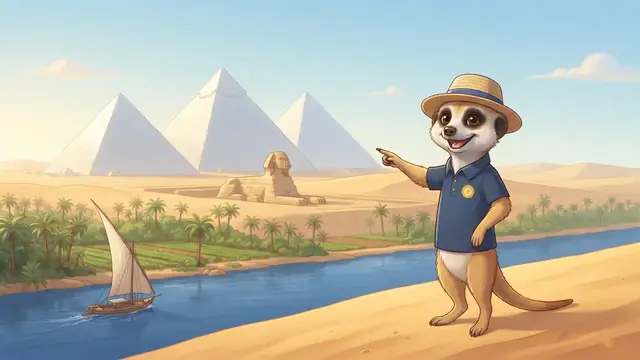
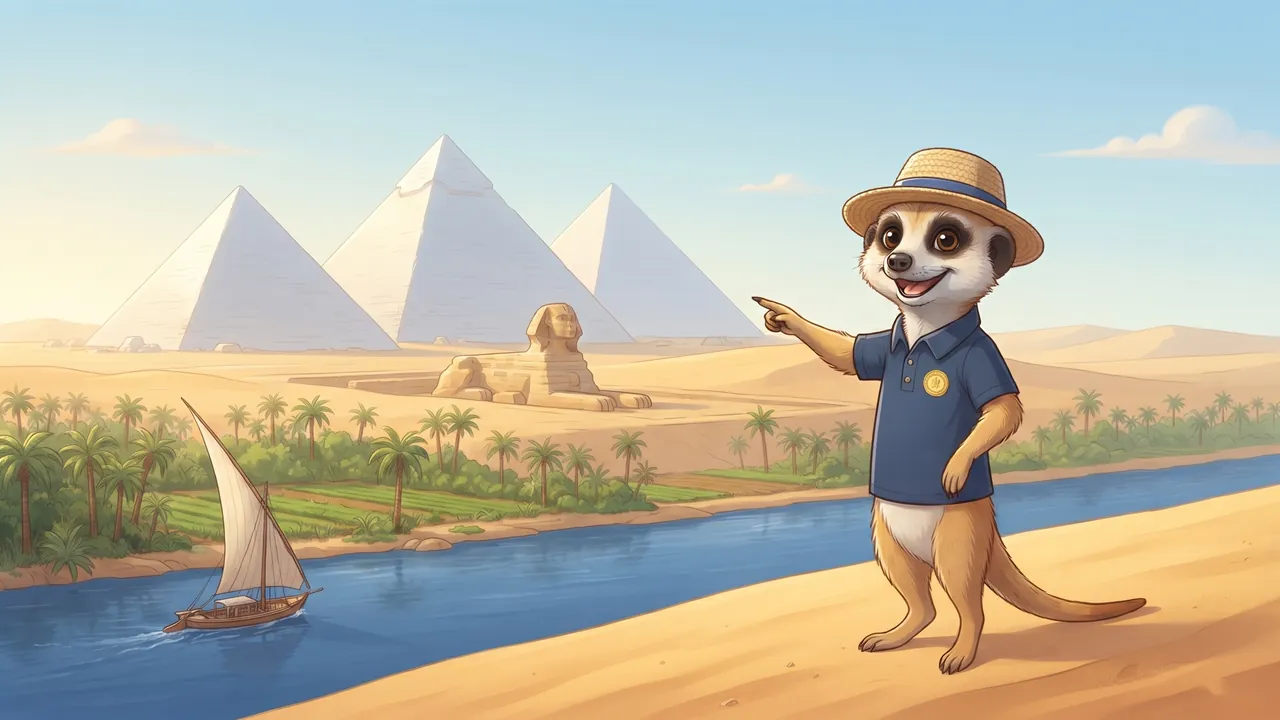
The Egyptians called the Nile Iteru, and the black, fertile land along it Kemet. Most Egyptians were farmers; wheat was the main crop, and flax was grown for linen. A shaduf lifts water from the Nile: a weight helps lift the bucket. Most of Egypt is desert (the “red land”), so almost everyone lived on the narrow strip of fertile land along the Nile and in the delta. The Nile was also Egypt’s main road: boats floated north with the current and sailed south with the wind, carrying people, grain and stone for the pyramids. The year had three seasons: flood, planting and growing, and harvest.
Society
- The vizier was the pharaoh’s chief official who ran the country. Priests looked after the temples and ceremonies.
- Scribes could read and write, which few could; that is why they were above farmers. Craftsmen: potters, carpenters, goldsmiths.
- Farmers gave part of the harvest as tax, and worked on the pharaoh’s building projects during the flood.
- Hatshepsut was a female pharaoh. The pyramid stones were moved on sledges by workers.
- Temples were seen as the homes of the gods. Priests cared for the god’s statue inside and held ceremonies and festivals there. Famous temples are Karnak and Luxor at Thebes, and Abu Simbel, built by Ramesses II.
Death and the afterlife
Anubis (jackal-headed) was the god of mummies and tombs; Osiris ruled over the dead. Cats were often mummified, linked to the goddess Bastet. We know so much about Egypt because they wrote, and tombs were preserved.
Remember this and test yourself
- The Nile was the heart of Egypt: the yearly flood left rich black soil — “the gift of the Nile”.
- The Nile flows from south to north into the Mediterranean; the White Nile starts at Lake Victoria, the Blue Nile at Lake Tana (Ethiopia).
- The kings were pharaohs; the pyramids (at Giza, near Cairo) were their tombs.
- Hieroglyphics is picture writing on papyrus; the Rosetta Stone helped scholars decipher it.
- A mummy is a body preserved for the afterlife.
Write these points in your book. Read them again the night before the test.

The Nile flows “up” the map to the sea: it starts in the south and flows north into the Mediterranean. Rivers flow downhill, not ‘down’ the map.
Important words
First say what the word means, then turn the card over.
Match column A to column B
Tap a word in column A, then its meaning in column B. You can also start in column B.
True or false?
Read the question and the answer. Is the answer right? Tap True or False.

Now the real quiz!
The quiz has many more questions on this topic. Every question shows straight away whether you are right and explains why.
Take the quiz: Ancient Egypt- Read one part together and ask your child to tell it back in their own words.
- The ticks (“I know this”) are saved on this device only. We never ask for names or emails.
Follows CAPS for Grade 5 Social Sciences (History). Always check your teacher’s notes and textbook too.