
Rivers and dams
The parts of a river, South Africa’s big rivers, and how dams help and affect people. Read one part at a time and tap “I know this”. Then test yourself in the quiz.
Know it already? Jump straight to the quiz
River words
| Word | Meaning |
|---|---|
| Source | Where the river begins, often on a mountain |
| Spring | Water flowing out of the ground |
| Tributary | A smaller river that joins a bigger one |
| Confluence | Where two rivers meet |
| Meander | A big bend or loop in a river |
| Mouth | Where the river ends in the sea or a lake |
| Estuary | The wide part of the river near its mouth, where fresh river water and salty sea water mix |
| Delta | Fan-shaped land where the river splits |
| Catchment area | All the land that drains into a river |
| River system | A main river together with all its tributaries, such as the Orange with the Vaal and the Caledon |
Rivers flow from high ground to low ground because gravity pulls water downhill. Upstream is towards the source.
South Africa’s rivers
- The Orange River (Gariep) rises in the mountains of Lesotho (the Drakensberg) and flows west, past Upington and over the Augrabies Falls, to the Atlantic Ocean at Alexander Bay. Its main tributaries are the Vaal and the Caledon.
- The Vaal River rises in Mpumalanga and flows west until it joins the Orange: it is a tributary.
- The Limpopo River forms part of the border with Botswana and Zimbabwe and flows east through Mozambique to the Indian Ocean; Beitbridge is the border post to Zimbabwe. It begins where the Crocodile and Marico rivers meet, and the Olifants River is a big tributary.
- The Thukela (Tugela) rises in the Drakensberg and flows east across KwaZulu-Natal to the Indian Ocean.
- Zambia and Zimbabwe share the Victoria Falls; the Nile flows north into the Mediterranean.
Dams: good and bad
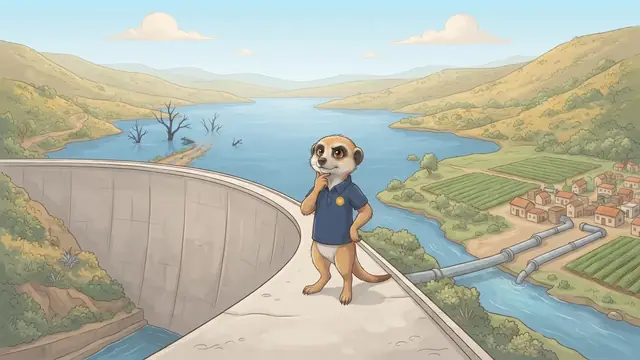
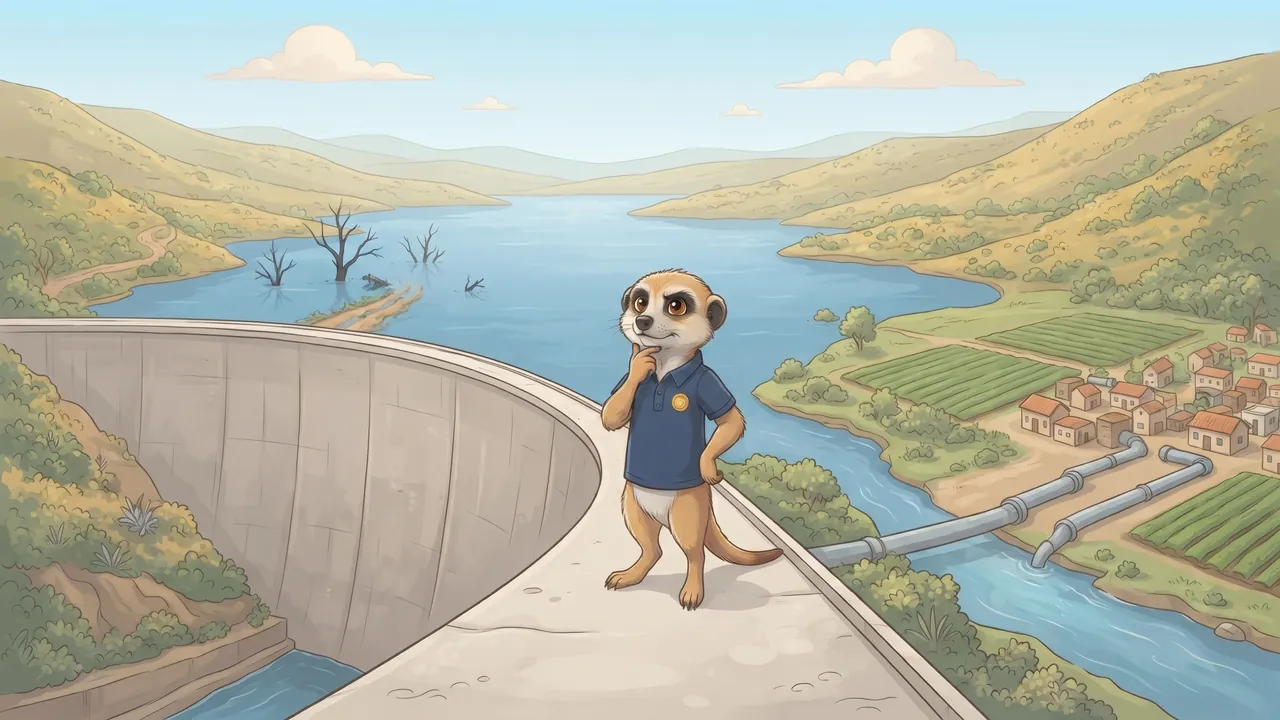
A dam is a wall built across a river. The Gariep Dam is South Africa’s largest dam. Engineers build dams in narrow river valleys, because there a short wall can hold back lots of water.
| Good | Bad |
|---|---|
| Stores water for farms and towns | Farms and homes upstream are flooded by the new lake |
| Holds back extra water during floods | People downstream may get less water |
Remember this and test yourself
- A river begins at its source (often a spring on a mountain) and ends at its mouth.
- A confluence is where two rivers meet; a meander is a big bend; a delta is fan-shaped land at the mouth.
- The Vaal is a tributary of the Orange; the Limpopo forms part of the border with Botswana and Zimbabwe.
- The Gariep Dam is our largest dam. Dams store water and hold back floods.
- A new dam floods land upstream, and people downstream may get less water.
Write these points in your book. Read them again the night before the test.

Source = Start. A tributary joins the river like a branch joins a tree trunk.
Important words
First say what the word means, then turn the card over.
Match column A to column B
Tap a word in column A, then its meaning in column B. You can also start in column B.
True or false?
Read the question and the answer. Is the answer right? Tap True or False.

Now the real quiz!
The quiz has many more questions on this topic. Every question shows straight away whether you are right and explains why.
Take the quiz: Rivers and dams- Read one part together and ask your child to tell it back in their own words.
- The ticks (“I know this”) are saved on this device only. We never ask for names or emails.
Follows CAPS for Grade 5 Social Sciences (Geography). Always check your teacher’s notes and textbook too.