
Minerals and mining
What minerals are, how we mine, South Africa’s important minerals, and the good and bad sides of mining. Read one part at a time and tap “I know this”. Then test yourself in the quiz.
Know it already? Jump straight to the quiz
What is a mineral?
A mineral is a natural substance we take from the Earth, such as gold, diamonds and iron ore. Minerals are non-renewable: they form over millions of years, and we use them up much faster. Coal is also mined, but it is not a mineral: it formed from the remains of plants. Oil, gas and coal together are called fossil fuels.
| Mineral or coal | Where | Use |
|---|---|---|
| Gold | Witwatersrand, Gauteng | Jewellery; rare and does not rust |
| Coal | Mpumalanga | Electricity |
| Platinum | North West | SA produces the most in the world |
| Diamonds | Kimberley | The Big Hole is an old mine dug by hand |
| Iron ore | Northern Cape | Steel |
How we mine
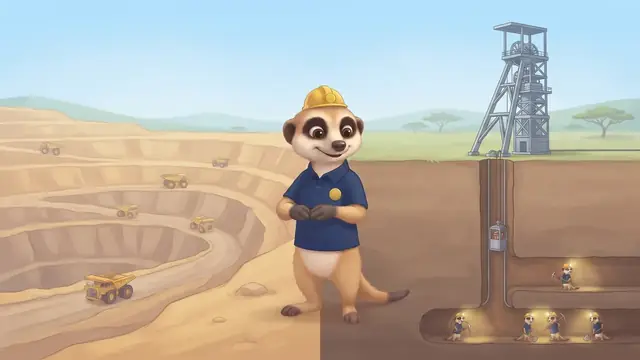
- Open-cast mining (open-pit or surface mining): the ground is dug away in steps in a huge open pit. It is used when the ore or coal lies close to the surface, such as iron ore at Sishen (Kathu) and coal in Mpumalanga. It is cheaper and safer, but it damages a large area of land.
- Underground mining (shaft or deep-level mining): miners go down a deep shaft in a lift (the cage). It is used when the ore lies deep, such as gold on the Witwatersrand and platinum. It is more expensive and more dangerous.
- An alluvial diamond is found in a river.

Good and bad
| Advantages | Disadvantages |
|---|---|
| Jobs for many people | Land is cleared; animals lose their homes |
| Export income for the country | Mine dumps (waste rock) and acidic, toxic mine water |
| Towns and railways grow | Mine work is dangerous |
| Coal and minerals for power stations and factories | Dust blowing from mine dumps and open pits pollutes the air |
Waste rock is piled on mine dumps, and fine, wet waste is kept in tailings dams. Planting grass on the dumps stops the dust from blowing.
Mines are often linked to a railway line, because trains move heavy ore cheaply. When a mine closes, many people lose their jobs, and the company must rehabilitate (restore) the land.
Illegal mining is mining without a permit. It is very dangerous, because old shafts have no fresh air or supports.
Recycle metals
Iron, aluminium and copper can be melted down and used again: they are recyclable metals. Recycling saves minerals that cannot grow back.
Remember this and test yourself
- A mineral is a natural substance from the Earth. Minerals are non-renewable: once used up, they are gone.
- Two methods: open-cast mining (a big pit in steps) and underground mining (shafts).
- Gold: Witwatersrand (Gauteng); coal: Mpumalanga, for power; platinum: North West; diamonds: Kimberley.
- Mining creates jobs and export income, but harms the environment.
- After a mine closes, the company must rehabilitate the land.
Write these points in your book. Read them again the night before the test.

Gold in Gauteng (“place of gold”); coal at eMalahleni (“place of coal”).
Important words
First say what the word means, then turn the card over.
Match column A to column B
Tap a word in column A, then its meaning in column B. You can also start in column B.
True or false?
Read the question and the answer. Is the answer right? Tap True or False.

Now the real quiz!
The quiz has many more questions on this topic. Every question shows straight away whether you are right and explains why.
Take the quiz: Minerals and mining- Read one part together and ask your child to tell it back in their own words.
- The ticks (“I know this”) are saved on this device only. We never ask for names or emails.
Follows CAPS for Grade 5 Social Sciences (Geography). Always check your teacher’s notes and textbook too.