
Planet Earth and the Moon: features and stories
The Earth’s shape, layers, continents and oceans, the Moon’s surface, and stories about the Moon. Read one part at a time and tap “I know this”. Then test yourself in the quiz.
Know it already? Jump straight to the quiz
The Earth
- A continent is a very large area of land; an island has water all around, like Robben Island in Table Bay.
- South Africa lies in Africa, between the Atlantic and the Indian Ocean.
- Antarctica is almost completely covered in ice. Most of the water on Earth is salt water.
The Earth and the Moon compared
| Earth | Moon | |
|---|---|---|
| Air | Yes, an atmosphere | No |
| Liquid water | Yes | No |
| Life | Yes | No |
| Size | Like a soccer ball | Like a tennis ball |
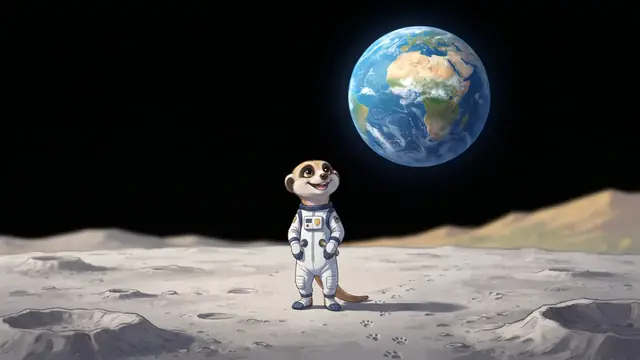
The Moon is much smaller than the Sun, but they look about the same size in our sky because the Moon is much closer. The round craters are holes made by crashing space rocks.

Stories and facts
Long ago people told stories about the Moon to explain what they saw and to teach lessons. Some people see a hare or a face in the full moon: these are really dark and light patches on the Moon’s surface.
An example: the ǀXam San told that the Mantis, ǀKaggen, threw one of his leather shoes up into the night sky, and it became the Moon. That is why, they said, the Moon is cold (it is only leather) and sometimes looks reddish (from the red dust on the shoe). The story explains where the Moon came from; science explains the Moon with facts we can test: it is a ball of rock that reflects sunlight.
A fact can be tested (the Moon moves around the Earth); a traditional story cannot.

The Earth is not too hot and not too cold: just right for life, with water, air, warmth and sunlight.
Remember this and test yourself
- The Earth is a sphere, made of rock, and mostly covered with water.
- The layers from the outside in: crust, mantle, core. The core is hot iron and nickel.
- There are seven continents (Asia is the largest) and five oceans (the Pacific is the largest).
- The atmosphere gives us air (oxygen), traps warmth and blocks harmful rays.
- The Moon has craters, rock and grey dust, but no air, wind or rain.
Write these points in your book. Read them again the night before the test.
The Earth is a boiled egg: shell = crust, white = mantle, yolk = core.
Important words
First say what the word means, then turn the card over.
Match column A to column B
Tap a word in column A, then its meaning in column B. You can also start in column B.
True or false?
Read the question and the answer. Is the answer right? Tap True or False.

Now the real quiz!
The quiz has many more questions on this topic. Every question shows straight away whether you are right and explains why.
Take the quiz: Planet Earth and the Moon: features and stories- Read one part together and ask your child to tell it back in their own words.
- The ticks (“I know this”) are saved on this device only. We never ask for names or emails.
Follows CAPS for Grade 4 Natural Sciences and Technology. Always check your teacher’s notes and textbook too.