
Animals and their needs
What animals need, what they eat, and how we sort them into groups. Read one part at a time and tap “I know this”. Then test yourself in the quiz.
Know it already? Jump straight to the quiz
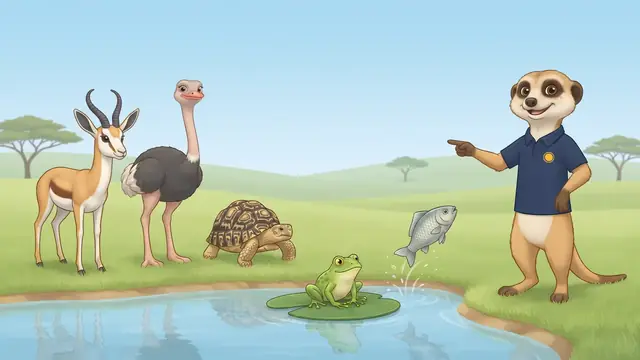
What do animals eat?
| Group | Eats | Example |
|---|---|---|
| Herbivore | Only plants | Zebra, giraffe |
| Carnivore | Only meat | Leopard, lion |
| Omnivore | Plants and meat | Baboon, human |
| Scavenger | Dead animals | Vulture, hyena |
Animals in groups
| Vertebrates | How do you recognise them? |
|---|---|
| Mammals | Hair or fur; young drink milk |
| Birds | Feathers and a beak; lay eggs |
| Reptiles | Dry skin with scales |
| Amphibians | Moist skin; tadpole becomes frog |
| Fish | Gills and fins |
Invertebrates have no backbone inside: insects, spiders, worms and snails.
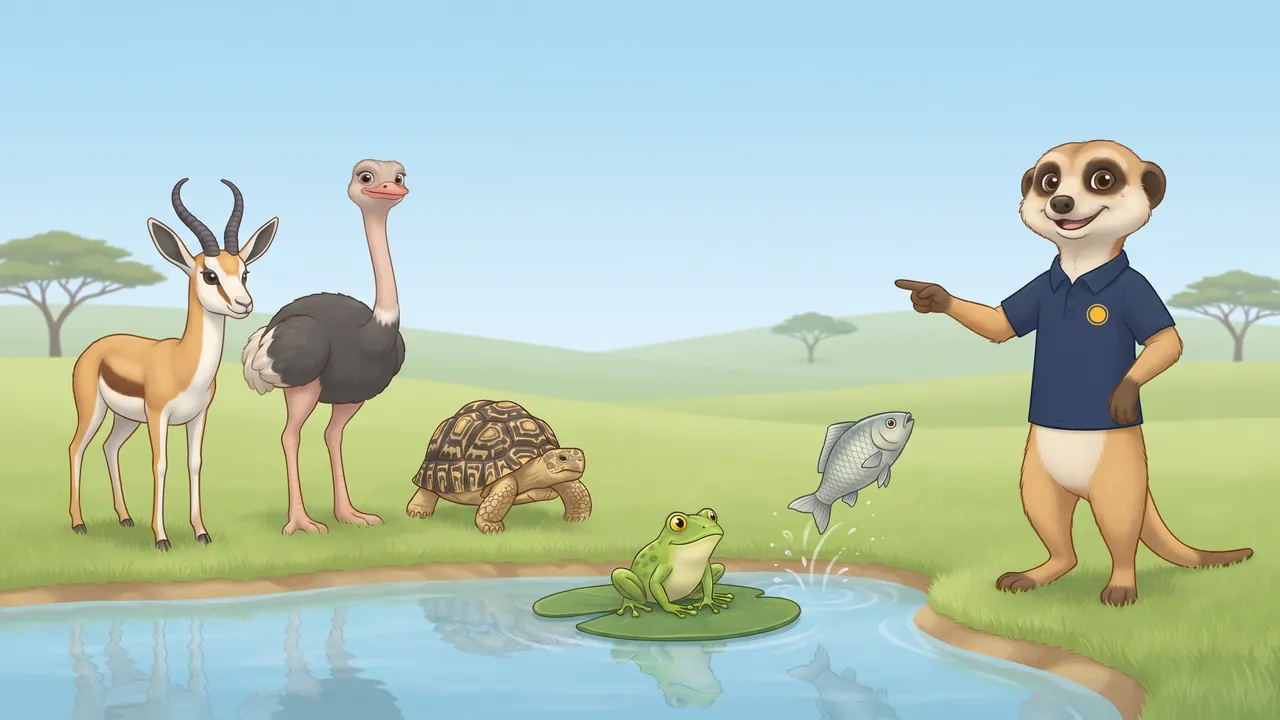
Body parts that help
- Thick fur keeps warm; an elephant’s large ears help it lose heat.
- Camouflage helps an animal blend into its surroundings.
- Predators have eyes at the front of the head to judge distance.
- Nocturnal animals are active at night; some animals hibernate in a cold winter.
- A fish lays far more eggs than a bird, because few of its eggs survive.
- Most animals have a head (with eyes, ears, a nose and a mouth), a body and limbs such as legs, wings or fins. Many also have a tail. Animals differ in their body covering (fur, feathers, scales, moist skin) and in how many legs they have: an insect has 6, a spider 8 and a bird 2.
Remember this and test yourself
- All animals need food, water, air and shelter.
- Herbivores eat plants, carnivores eat meat, omnivores eat both.
- Vertebrates have a backbone: mammals, birds, reptiles, amphibians and fish.
- Mammals feed their young with milk; birds have feathers; fish breathe with gills.
- Invertebrates have no backbone, like spiders and insects.
Write these points in your book. Read them again the night before the test.

Herbi = herbs (plants), carni = carne, meat, omni = omni-everything (both).
Important words
First say what the word means, then turn the card over.
Match column A to column B
Tap a word in column A, then its meaning in column B. You can also start in column B.
True or false?
Read the question and the answer. Is the answer right? Tap True or False.

Now the real quiz!
The quiz has many more questions on this topic. Every question shows straight away whether you are right and explains why.
Take the quiz: Animals and their needs- Read one part together and ask your child to tell it back in their own words.
- The ticks (“I know this”) are saved on this device only. We never ask for names or emails.
Follows CAPS for Grade 4 Natural Sciences and Technology. Always check your teacher’s notes and textbook too.