
Free Grade 7 English lesson: Gender: masculine and feminine
The gender rules for the Senior Phase. Read the rule, practise it straight away, then tap “I understand this”.
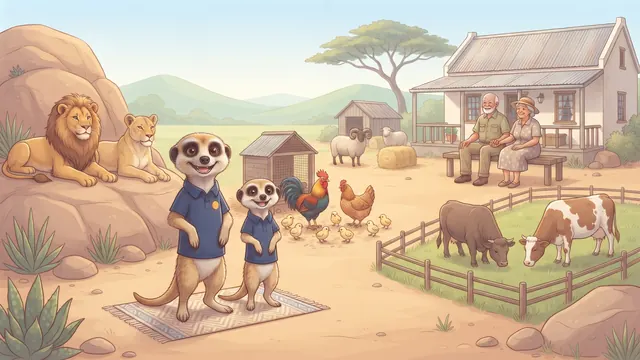
- Know all the ways to form a feminine noun.
- Learn royal and noble titles: tsar – tsarina, earl – countess.
- Learn unusual animal pairs: billy goat – nanny goat, drone – queen bee.
- Use common-gender and gender-neutral words correctly.
- Change long sentences, including pronouns and possessives.
All the ways in one table
There are four main ways to form a feminine noun.
Colours: blue = masculine · red = feminine
| Way | Examples |
|---|---|
| a different word | king – queen, ram – ewe, monk – nun |
| a suffix | host – hostess, hero – heroine, usher – usherette, sultan – sultana, tsar – tsarina |
| change part of a compound | landlord – landlady, grandfather – grandmother |
| add a word in front | billy goat – nanny goat, bull elephant – cow elephant |
The suffixes are -ess, -ine, -ette, -a and -ina. Most words use -ess.
Which way?
Choose how the feminine is formed.
Royal and noble titles
These titles appear in history texts and stories.
| Masculine | Feminine |
|---|---|
| emperor | empress |
| tsar | tsarina |
| duke | duchess |
| earl | countess |
| viscount | viscountess |
| baron | baroness |
Earl is the odd one: its feminine is countess, not earless.
Titles
Choose the correct feminine.
Unusual animal pairs
Learn the pairs that exams like to ask.
Colours: blue = masculine · red = feminine
| Animal | Male | Female |
|---|---|---|
| goat | billy goat | nanny goat |
| bee | drone | queen (the egg layer) |
| swan | cob | pen |
| zebra / horse | stallion | mare |
| whale / elephant | bull | cow |
For animals without special words, say male and female: a male meerkat, a female meerkat.
Animal pairs
Choose the right word.
Common gender and gender-neutral words
Many nouns are common gender: they can refer to anyone (teacher, doctor, sibling, spouse, monarch).
Today we often use gender-neutral words for jobs: firefighter, police officer, flight attendant, chairperson.
In an exam, if you are asked for the feminine, give it (actress, waitress). In your own writing, neutral words such as actor for everyone and server are also correct.
Do not invent feminine forms: not doctoress or teacheress.
Common or neutral?
Choose the best answer.
Change long sentences
Change every masculine noun, pronoun (he, him, himself) and possessive (his).
| Masculine | Feminine |
|---|---|
| he | she |
| him | her |
| his (book) | her (book) |
| his (it is his) | hers |
| himself | herself |
Read the sentence aloud at the end to check every he and his.
What must change?
Tap all the words that must change if the sentence becomes feminine.
How it can look in the test

Teachers ask the same thing in different ways. Try each question on paper first, then tap to see the answer. The number in brackets is the marks.
- Feminine1.
Give the feminine:
a) earl · b) usher · c) tsar · d) proprietor (4)Show the answer
Answer: a) countess · b) usherette · c) tsarina · d) proprietress
Marks: 1 mark each.
- Gender2.
Give the gender:
a) spouse · b) drone · c) castle (3)Show the answer
Answer: a) common · b) masculine · c) neuter
Marks: 1 mark each.
- Change3.
Rewrite in the feminine:
The sorcerer gave his wand to his nephew, because it was his. (5)Show the answer
Answer: The sorceress gave her wand to her niece, because it was hers.
Marks: 1 mark each.
Remember it and test yourself
Tap a block to open it.
Remember this: your summary5 points
- Four ways: a different word, a suffix (-ess, -ine, -ette, -a, -ina), part of a compound, a word in front (nanny goat).
- Titles: empress, tsarina, duchess, countess (earl), viscountess, baroness.
- Animals: billy – nanny goat, drone – queen bee, cob – pen, bull – cow (whale).
- Common gender: sibling, spouse, monarch. Neutral job words: firefighter, police officer.
- Change he → she, him → her, his → her/hers, himself → herself.
Watch out!3 easy mistakes
- Not: earless But: countess
- Not: doctoress But: doctor (common gender)
- Not: The duchess said it was his. But: The duchess said it was hers.
What the exam asks3 question types
- Give the feminine or masculine of titles and unusual pairs.
- Give the gender including common gender words.
- Rewrite a long sentence with pronouns and possessives.
Quick questions
Tap an answer. If you get one wrong, read why and go back to that step.
 You have ticked all 5 steps! Now you are ready for the quiz.
Ready to practise? In the Grade 7 English quiz, choose Gender: masculine and feminine.
- One step a day is enough. Play “He or she?”: you say a word, your child gives the pair.
- Talk about job names together: which have a feminine form, and which neutral words do we use today?
- The ticks (“I understand this”) are saved on this device only. We do not ask for names or emails.
Follows CAPS for Grade 7 English Home Language. Always check your teacher’s notes as well.
What this Grade 7 English lesson on gender covers
This free, interactive Grade 7 English lesson takes your child step by step through masculine and feminine nouns, following CAPS for English Home Language. all the ways to form the feminine, royal and noble titles, unusual animal pairs, common gender and gender-neutral words, and changing long sentences, with practice.
After every rule your child practises straight away, and every answer is marked at once with a short explanation. Then practise in the free Grade 7 English quiz.