
The history and functions of money
From barter to electronic money, the functions of money, and the qualities of good money. Read one part at a time and tap “I know this”. Then test yourself in the quiz.
Know it already? Jump straight to the quiz

From swapping to clicking
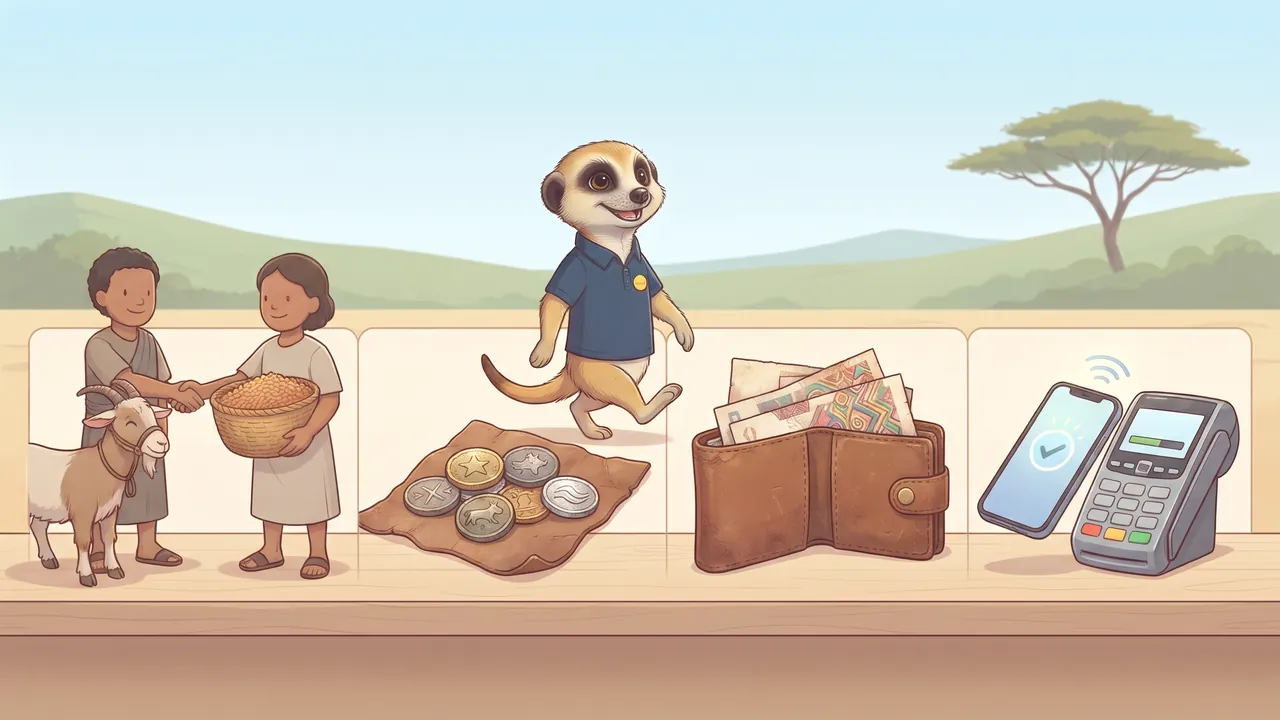
Long ago people made most things themselves and swapped the rest. A farmer wants shoes, but the shoemaker does not want his cabbages: that is the problem with barter. Metal coins were better than cattle: they last and can be split into small amounts. Paper money came because lots of coins were heavy and unsafe to carry.
The functions of money
| Function | Example |
|---|---|
| Medium of exchange | You buy bread with money instead of swapping |
| Unit of account | All prices in rand: you can compare bread with shoes |
| Store of value | Put R20 a week away for a bicycle |
Money lets people specialise: they earn with one job and buy the rest. A shopping list is not money.
Safe money
- Bank notes have watermarks, metal strips and raised print to make them hard to forge; fake money makes people stop trusting money.
- A promissory note is a written promise to pay; a cheque was a written order for your bank to pay. South African banks stopped accepting cheques at the end of 2020: EFTs and cards replaced them.
- Spaza shops accept card and phone payments: fewer people carry cash, and it is safer. But scammers try to steal your details.
- Electronic banking: at an ATM you draw cash or check your balance; an EFT (electronic funds transfer) moves money from one account to another; internet and cellphone banking let you pay accounts on your phone. Phishing is when scammers send fake messages to steal your PIN or password.
Remember this and test yourself
- The problem with barter: both must want what the other has.
- Early money: cattle, salt, beads and shells; then coins, paper money and electronic money.
- Three functions: medium of exchange (buying), unit of account (comparing prices), store of value (saving).
- Good money is durable, easy to carry, divisible and hard to copy.
- The rand (100 cents) is issued by the South African Reserve Bank.
Write these points in your book. Read them again the night before the test.

Money’s three jobs: Buy (medium of exchange), Compare (unit of account), Keep (store of value).
Important words
First say what the word means, then turn the card over.
Match column A to column B
Tap a word in column A, then its meaning in column B. You can also start in column B.
True or false?
Read the question and the answer. Is the answer right? Tap True or False.

Now the real quiz!
The quiz has many more questions on this topic. Every question shows straight away whether you are right and explains why.
Take the quiz: The history and functions of money- Read one part together and ask your child to tell it back in their own words.
- The ticks (“I know this”) are saved on this device only. We never ask for names or emails.
Follows CAPS for Grade 7 Economic and Management Sciences (EMS). Always check your teacher’s notes and textbook too.