
Sources and timelines
Primary and secondary sources, bias, reliability, timelines, centuries and the abbreviations BC, AD, BCE and CE. Read one part at a time and tap “I know this”. Then test yourself in the quiz.
Know it already? Jump straight to the quiz
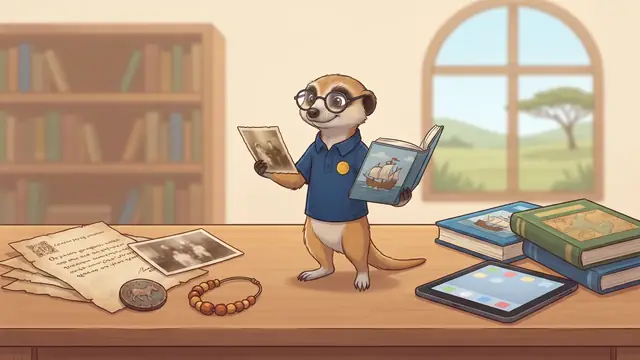
Kinds of sources
| Source | Kind |
|---|---|
| A piece of old pot dug up | Archaeological (an artefact: made and used by people) |
| An elder who grew up there | Oral: important in Africa, where knowledge was told |
| An official record | Carefully kept at the time |
| A newspaper cartoon | A drawing that gives an opinion |
A fact can be checked; an opinion cannot. History books change because new sources are found.
Time
Century = 100 years, millennium = 1 000 years. 1488 comes before 1652.
Remember this and test yourself
- Primary: from the time itself (a 1994 ballot paper). Secondary: written later.
- Ask who wrote the source: the writer’s interest can colour it (bias).
- More reliable when independent sources agree; less reliable when it contradicts all the others or exaggerates.
- Chronological order: events in the order they happened.
- BC (Before Christ) and AD (Anno Domini, “in the year of our Lord”); or BCE (Before the Common Era) and CE (Common Era): the numbers stay the same. Years BC count backwards: 400 BC is older than 100 BC.
Write these points in your book. Read them again the night before the test.

Primary = first-hand (was there). Secondary = second-hand (told later).
Important words
First say what the word means, then turn the card over.
Match column A to column B
Tap a word in column A, then its meaning in column B. You can also start in column B.
True or false?
Read the question and the answer. Is the answer right? Tap True or False.

Now the real quiz!
The quiz has many more questions on this topic. Every question shows straight away whether you are right and explains why.
Take the quiz: Sources and timelines- Read one part together and ask your child to tell it back in their own words.
- The ticks (“I know this”) are saved on this device only. We never ask for names or emails.
Follows CAPS for Grade 6 Social Sciences (History). Always check your teacher’s notes and textbook too.