
Trade in South Africa and the world
Exports and imports, harbours and transport, and how trade affects countries and people. Read one part at a time and tap “I know this”. Then test yourself in the quiz.
Know it already? Jump straight to the quiz
Exports and imports
Countries trade because no country can make everything itself. Exporting is selling goods to another country; importing is buying goods from another country. If a country exports more than it imports, more money comes in than goes out.
| South Africa exports | South Africa imports |
|---|---|
| Gold, platinum, coal and other minerals | Crude oil (we do not produce enough ourselves) |
| Fruit and wine | Machines and electronic devices |
| Tourism (a service) |
- Raw materials are natural materials, such as iron ore, cotton and timber, that have not yet been processed in a factory.
- The trade balance is the difference between exports and imports.
- An import duty is a tax on goods brought into a country.
Harbours, ships and trains
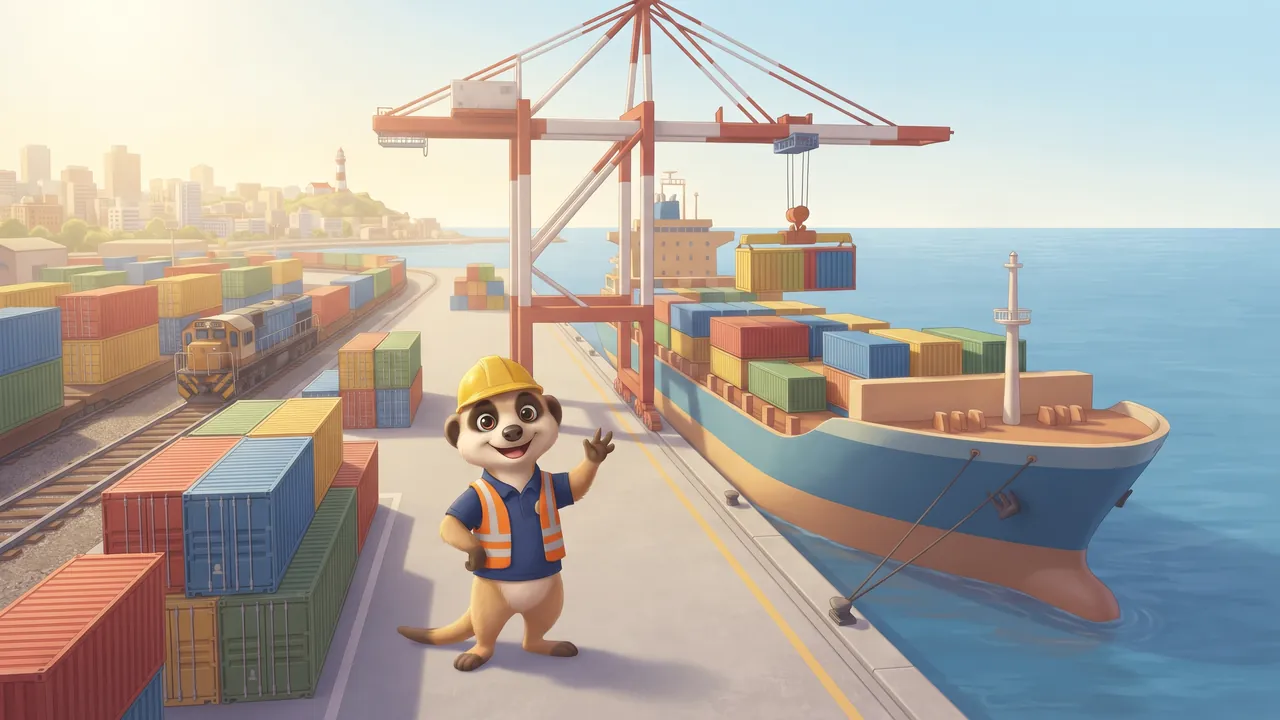
Ships carry the most cargo over long distances, in large steel containers. A harbour is where ships load and unload. Trains carry heavy cargo cheaply over land, and good roads and railways get goods to the markets.
- Durban is South Africa’s busiest container harbour.
- Richards Bay exports the most coal.
Who wins from trade?
- Shoppers get more choice at lower prices, and goods not made locally.
- When cheap imports flood in, local factories struggle to compete.
- The exchange rate is the value of one currency in another.
- A trade bloc is a group of countries trading together; trade between two countries is bilateral trade.
Fair trade pays farmers a fair price. Buy products with a fair-trade label to support farmers who are treated fairly.
Remember this and test yourself
- Export = sell to another country; import = buy from another country.
- South Africa exports mainly minerals and metals (gold, platinum, coal) and imports crude oil.
- Ships carry the most cargo; Durban is the busiest container harbour; Richards Bay exports the most coal.
- The trade balance is the difference between exports and imports; the exchange rate is one currency’s value in another.
- Fair trade pays farmers a fair price; exploitation is treating workers unfairly.
Write these points in your book. Read them again the night before the test.

Export = goods exit the country (sell). Import = goods come in (buy).
Important words
First say what the word means, then turn the card over.
Match column A to column B
Tap a word in column A, then its meaning in column B. You can also start in column B.
True or false?
Read the question and the answer. Is the answer right? Tap True or False.

Now the real quiz!
The quiz has many more questions on this topic. Every question shows straight away whether you are right and explains why.
Take the quiz: Trade in South Africa and the world- Read one part together and ask your child to tell it back in their own words.
- The ticks (“I know this”) are saved on this device only. We never ask for names or emails.
Follows CAPS for Grade 6 Social Sciences (Geography). Always check your teacher’s notes and textbook too.