
Rainfall patterns
How we measure rain, when and where it rains in South Africa, and what droughts and floods are. Read one part at a time and tap “I know this”. Then test yourself in the quiz.
Know it already? Jump straight to the quiz
Measuring rain
We measure rain with a rain gauge, in millimetres (mm). If the gauge shows 50 mm, the rainwater would stand 50 mm deep on the ground if it had not run away.
South Africa gets on average about 460 mm of rain a year, less than the world average. That is why water is precious and we must save it. An area that gets very little rain is an arid area.
Summer rain and winter rain
Most of South Africa gets its rain in summer, often as afternoon thunderstorms. The Highveld usually gets the most rain in January. The south-western Cape, around Cape Town, is different: it gets its rain in winter. A narrow strip along the southern Cape coast (the Garden Route, such as George and Knysna) gets rain in all seasons: all-year rainfall.
- Summer rainfall: most of the country (the Highveld, KwaZulu-Natal, Limpopo, the Free State).
- Winter rainfall: the south-western Cape around Cape Town.
- All-year rainfall: the southern Cape coast (the Garden Route), which gets rain in every season.

Farmers plant according to the rainfall pattern, because crops need rain at the right time.
Too little or too much
| Drought | Flood |
|---|---|
| A long time with much less rain | Too much rain in a short time; water spills over the land |
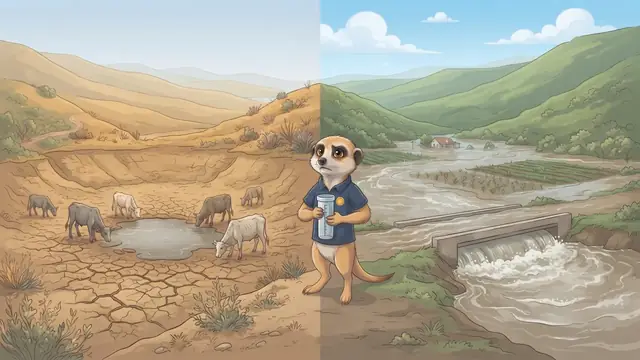
| Dams run dry; a town’s water can run out | Homes, roads and crops are damaged |
| Help: save water, catch rainwater | Help: do not build on a floodplain |

Rain and plants
Where more rain falls, plants grow more densely. Where little rain falls, plants are sparse and spread out. On a bare slope rainwater runs off faster, because there are no plants to slow it. Water soaking into the ground is called infiltration.
Remember this and test yourself
- Rain is measured in millimetres (mm) with a rain gauge.
- Most of South Africa gets summer rain; the south-western Cape gets winter rain; the southern Cape coast gets all-year rain.
- We get on average about 460 mm a year, less than the world average: water is precious.
- A drought is a long time with little rain; a flood is water spilling over the land.
- More rain gives denser plant growth; a climate graph shows rain and temperature together.
Write these points in your book. Read them again the night before the test.

Cape Town gets its rain in the cold season (winter); the Garden Route gets rain all year; the rest of the country in the warm season (summer).
Important words
First say what the word means, then turn the card over.
Match column A to column B
Tap a word in column A, then its meaning in column B. You can also start in column B.
True or false?
Read the question and the answer. Is the answer right? Tap True or False.

Now the real quiz!
The quiz has many more questions on this topic. Every question shows straight away whether you are right and explains why.
Take the quiz: Rainfall patterns- Read one part together and ask your child to tell it back in their own words.
- The ticks (“I know this”) are saved on this device only. We never ask for names or emails.
Follows CAPS for Grade 5 Social Sciences (Geography). Always check your teacher’s notes and textbook too.